Showing posts with label LHC. Show all posts

Wednesday, September 10, 2008

Very Basic Q & A about CERN collider

Questions and answers about the CERN collider

GENEVA (AP) — Questions and answers about the Large Hadron Collider:

Q: What is the Large Hadron Collider?

A: It is the world's most powerful particle accelerator. It is buried inside a 17-mile tunnel and surrounded by massive detectors.

Q: What does "hadron" refer to?

A: It is a particle, such as a proton or neutron, found in the nucleus of an atom.

Q: How long did it take to build the collider, who is involved, and how much did it cost?

A: The project was conceived in 1984 by scientists at the European Organization for Nuclear Research, or CERN. The organization's 20 member nations along with observer countries such as the United States and Japan have contributed $10 billion.

Q: How does the collider work?

A: The collider fires protons around the tunnel at near the speed of light — more than 186,000 miles per second. Supercooled magnets guide the protons in opposite directions around a near-vacuum until they collide at four points inside the tunnel.

Q: What do the detectors do?

A: As protons collide, the detectors will search for evidence of extra dimensions — apart from the three dimensions of space and one dimension of time.

They will also look for the "dark matter" believed to make up most of the universe, antimatter that mirrors all known matter, and the elusive Higgs-boson particle — sometimes called the "God particle," because it is believed to give mass to all other particles. All of these have previously only been theorized, but not confirmed.

One of the detectors will smash together lead ions to simulate conditions shortly after the "big bang"_ the event believed to have created the universe 13.7 billion years ago. Scientists hope to learn from this how matter was formed.

Q: Is the experiment safe?

A: Some people fear the collider could create black holes or release massive amounts of energy that would destroy Earth. CERN and leading particle physicists insist there is no danger. Other scientists have calculated the odds of this happening as too minute to worry about. This hasn't stopped bookmakers from taking bets from people willing to wager that the end of the world is near.

Q: What else do scientists hope to learn from the experiment?

A: If the collider proves the existence of new particles, it could test the dominant physics hypothesis of "string theory," which seeks to reconcile quantum mechanics and gravity in an all-encompassing formula that has eluded all scientists since Albert Einstein.

Q: Will the collider prove the existence of God?

A: The experiment will examine what happened shortly after the universe was created. It does not seek to confirm or deny the existence of any supernatural being.

Worlds Largest Below 2 Kelvin Fridge

Today, the world is standing in front of a Pandora’s Box, but the question is: are we ready to open it? The most brilliant minds of our time have gathered in Geneva to remove the mystery veil that has kept scientists from understanding some of the fundamental events in the Universe.

The Large Hadron Collider is a scientific instrument of a monumental scale and the world’s largest particle accelerator machine. It can be considered the world’s largest fridge, as it will ensure the optimal temperature (1.9 K or -271.3 °C) to protect the LHC from the extremely hot temperature generated by the colliding beams of protons, which can be 100,000 times hotter than the heart of the Sun.

All along the circular LHC accelerator, 9300 magnets (which will be pre-cooled at -193.2 °C (80 K) with 10,080 tones of liquid nitrogen) will be filled with 60 tones of liquid helium, which will bring their temperature further down, to -271.3 °C or 1.9 K.

Inside the accelerator, scientists have recreated the primordial conditions in space: the beams of particles will travel in an ultra-high vacuum resembling the interplanetary space, with internal pressures of 10-13 atm, ten times less the pressure of the moon.

On September 10, scientists will attempt to circulate a beam through the particle accelerator, in preparation for the bigger experiment scheduled to take place later this year, when they will attempt to achieve the acceleration and collision of two beams at the energy of 7 TeV per beam.

According to initial estimations, trillions of protons will travel 11,245 times a second at 99.99% the speed of light around the accelerator ring. According to scientists, 600 million collisions will take place every second. And if that isn’t impressive enough, a nominal proton in the LHC will have the energy equivalent to a person in a Subaru driving at 1700 kph.

Physicists around the world will conduct several experiments, hoping to understand more about our Universe and the principles of physics. The particle accelerator will be used to recreate the conditions after the Big Bang.

The ALICE experiment will collect data on quark-gluon plasma, a state of matter believer to have existed immediately after the Big Bang. ATLAS will attempt a bold search for the Higgs boson, also known as the “God particle,” a hypothetical elementary particle believed to exist, according to the Standard Model of physics, but not yet observed.

In addition to that, ATLAS will also try to make observations on extra dimensions and the particles that could make up dark matter. The CMS experiment will aim at the same goals as ATLAS, but using a different technique, which involves a huge detector magnet system.

The LHCb experiment will try to explain why our Universe appears to be composed of matter, but no antimatter (matter and antimatter have the same mass, but opposed electrical charge).

The TOTEM experiment, in addition to other measurement, will focus on the size of the proton and will monitor LHC’s luminosity. The results will complement data obtained by the CSM detector and other LHC experiments.

The Large Hadron Collider is the most ambitious scientific attempt ever, and is looking for answers that have been inaccessible to scientists so far. The results of the LHC experiment are expected to change what we thought we knew about the Universe, and hopefully turn the “God particle,” if it indeed exists, into a detectable particle.

The experiment has been highly mediatized, especially over the past weeks, when talks of the end of the world started to emerge. Regarding the concerns that the collisions might cause irreversible damage to our planet, or even completely destroy it, the LHC Safety Assessment Group explained that there is nothing to fear.

“Collisions just like those the LHC will make have been produced by cosmic rays bombarding the earth throughout its existence. It would take about 100,000 LHC experiments to match the number of cosmic rays that have already occurred. We can rest assured that our planet will not be affected by the four experiments about to be conducted in Geneva.”

The experiment will take place despite pessimistic, and ungrounded, foretells that September 10 will be the end of the world. The experiment will try to recreate primordial conditions in the Universe, but at a much reduced scale, incapable of producing the catastrophic events that have been predicted.

Tuesday, September 9, 2008

LHC experiment 1-6

http://freewareindia.blogspot.com/2008/09/lhcf-very-small-lhc-experiment-6.html


Biggest Atom Smasher (SubAtom (Hadron) Collider)

http://news.nationalgeographic.com/news/2008/09/080909-collider-startup.html

Large Hadron Collider - India excluded

A Nation that contributed to Bose-Einstien condenstate was excluded from collabration during the LHC experiment by CERN. Out of 37 countries, India is not a collabrating country. It is sad that CERN chose to ignore India

Wrong: large hydron collider, it is Large Hadron Collider

It is incorrect to call a hadron a hydron. The largest particle accelrator is for colliding Hadrons like protons. Hence the term Large Hadron Collider

Pion

pion

Neutral Pions created from cosmic rays interactions with atmosphere

ParticleSymbolAnti-
particle
Makeup
Rest mass
MeV/c2
SCBLifetime
Decay Modes
Pion
π+
π-
ud
139.6
0
0
0
2.60
x10-8
μ+νμ
Pion
π0
Self
135.0
0
0
0
0.83
x10-16
2γ

The neutral pion decays to an electron, positron, and gamma ray by the electromagnetic interaction on a time scale of about 10-16 seconds. The positive and negative pions have longer lifetimes of about 2.6 x 10⁻⁸ s.

The negative pion decays into a muon and a muon antineutrino as illustrated below. This decay is puzzling upon first examination because the decay into an electron plus an electron antineutrino yields much more energy. Usually the pathway with the greatest energy yield is the preferred pathway. This suggests that some symmetry is acting to inhibit the electron decay pathway.

The symmetry which suppresses the electron pathway is that of angular momentum, as described by Griffiths. Since the negative pion has spin zero, the electron and antineutrino must be emitted with opposite spins to preserve net zero spin. But the antineutrino is always right-handed, so this implies that the electron must be emitted with spin in the direction of its linear momentum (i.e., also right-handed). But if the electron were massless, it would (like the neutrino) only exist as a left-handed particle, and the electron pathway would be completely prohibited. So the suppression of the electron pathway is attributed to the fact that the electron's small mass greatly favors the left-handed symmetry, thus inhibiting the decay. Weak interaction theory predicts that the fraction of muons decaying into electrons should be 1.28 x 10⁻⁴ and the measured branching ratio is 1.23 +/- 0.02 x 10⁻⁴.

The pion, being the lightest meson, can be used to predict the maximum range of the strong interaction. The strong interaction properties of the three pions are identical. The connection between pions and the strong force was proposed byHideki Yukawa. Yukawa worked out a potential for the force and predicted its mass based on the uncertainty principle from measurements of the apparent rangeof the strong force in nuclei.

Being composed of an up and an antidown quark, the positive pion would be expected to have a mass about 2/3 that of a proton, yet it's mass is only about 1/6 of that of the proton! This is an example of how hadron masses depend upon the dynamics inside the particle, and not just upon the quarks contained.

The pion is a meson. The π+ is considered to be made up of an up and an anti-down quark. The neutral pion is considered to be a combination

Pions interact with nuclei and transform a neutron to a proton or vice versa:

The pions π+ and π- have spin zero and negative intrinsic parity (Rohlf Sec 17-2

Mesons

Mesons

Mesons are intermediate mass particles which are made up of a quark-antiquark pair. Three quark combinations are called baryons. Mesons arebosons, while the baryons are fermions. Recent experimental evidence shows the existence of five-quark combinations which are being calledpentaquarks.

Quarks

Quarks

Quarks and Leptons are the building blocks which build up matter, i.e., they are seen as the "elementary particles". In the present standard model, there are six "flavors" of quarks. They can successfully account for all known mesons andbaryons (over 200). The most familiar baryons are the proton and neutron, which are each constructed from up and down quarks. Quarks are observed to occur only in combinations of two quarks (mesons), three quarks (baryons), and the recently discovered particles with five quarks (pentaquark).

QuarkSymbolSpinChargeBaryon
Number
SCBTMass*
Up
U
1/2
+2/3
1/3
0
0
0
0
360 MeV
Down
D
1/2
-1/3
1/3
0
0
0
0
360 MeV
Charm
C
1/2
+2/3
1/3
0
+1
0
0
1500 MeV
Strange
S
1/2
-1/3
1/3
-1
0
0
0
540 MeV
Top
T
1/2
+2/3
1/3
0
0
0
+1
174 GeV
Bottom

B
1/2
-1/3
1/3
0
0
-1
0
5 GeV

*The masses should not be taken too seriously, because the confinement of quarks implies that we cannot isolate them to measure their masses in a direct way. The masses must be implied indirectly from scattering experiments. The masses quoted for the U and D are about 1/3 the mass of a proton, since we know the proton has three quarks. But in other combinations they contribute different masses. In the pion, an up and an anti-down quark yield a particle of only 139.6 MeV of mass energy, while in the rho vector meson the same combination of quarks has a mass of 770 MeV! The masses of C and S are from Serway, and the T and B masses are from descriptions of the experiments in which they were discovered.

Each of the six "flavors" of quarks can have three different "colors". The quark forces are attractive only in "colorless" combinations of three quarks (baryons), quark-antiquark pairs (mesons) and possibly larger combinations such as the pentaquark that could also meet the colorless condition. Quarks undergotransformations by the exchange of W bosons, and those transformations determine the rate and nature of the decay of hadrons by the weak interaction.

LHCf : Very Small LHC experiment 6

LHCf

Large Hadron Collider forward

The LHCf experiment uses forward particles created inside the LHC as a source to simulate cosmic rays in laboratory conditions.

Cosmic rays are naturally occurring charged particles from outer space that constantly bombard the Earth's atmosphere. They collide with nuclei in the upper atmosphere, leading to a cascade of particles that reaches ground level.

Studying how collisions inside the LHC cause similar cascades of particles will help scientists to interpret and calibrate large-scale cosmic-ray experiments that can cover thousands of kilometres.

The LHCf experiment involves 22 scientists from 10 institutes in 4 countries (September 2006).

LHCf detector

  • Size: two detectors, each measures 30 cm long, 80 cm high, 10 cm wide
  • Weight: 40 kg each
  • Design:
  • Location: Meyrin, Switzerland (near ATLAS) 

TOTEM: Very Small LHC experiment 5

TOTEM http://totem.web.cern.ch/Totem/

TOTal Elastic and diffractive cross section Measurement

The TOTEM experiment studies forward particles to focus on physics that is not accessible to the general-purpose experiments. Among a range of studies, it will measure, in effect, the size of the proton and also monitor accurately the LHC's luminosity.

To do this TOTEM must be able to detect particles produced very close to the LHC beams. It will include detectors housed in specially designed vacuum chambers called 'Roman pots', which are connected to the beam pipes in the LHC. Eight Roman pots will be placed in pairs at four locations near the collision point of the CMS experiment.

Although the two experiments are scientifically independent, TOTEM will complement the results obtained by the CMS detector and by the other LHC experiments overall.

The TOTEM experiment involves 50 scientists from 10 institutes in 8 countries (2006).

TOTEM detector

  • Size: 440 m long, 5 m high and 5 m wide
  • Weight: 20 tonnes
  • Design: Roman pot and GEM detectors and cathode strip chambers
  • Location: Cessy, France (near CMS) 

LHCb : LHC small experiment 4

LHCb http://lhcb-public.web.cern.ch/lhcb-public/

Large Hadron Collider beauty

The LHCb experiment will help us to understand why we live in a Universe that appears to be composed almost entirely of matter, but no antimatter.

It specialises in investigating the slight differences between matter and antimatter by studying a type of particle called the 'beauty quark', or 'b quark'.

Instead of surrounding the entire collision point with an enclosed detector, the LHCb experiment uses a series of sub-detectors to detect mainly forward particles. The first sub-detector is mounted close to the collision point, while the next ones stand one behind the other, over a length of 20 m.

An abundance of different types of quark will be created by the LHC before they decay quickly into other forms. To catch the b-quarks, LHCb has developed sophisticated movable tracking detectors close to the path of the beams circling in the LHC.

The LHCb collaboration has 650 scientists from 48 institutes in 13 countries (April 2006).

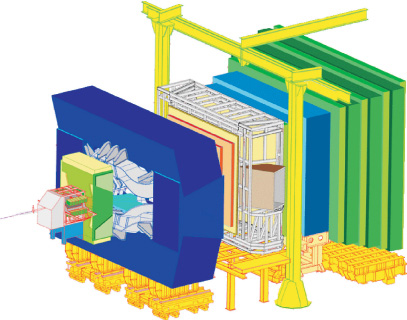
LHCb setup

LHCb detector

  • Size: 21m long, 10m high and 13m wide
  • Weight: 5600 tonnes
  • Design: forward spectrometer with planar detectors
  • Location: Ferney-Voltaire, France. 

ALICE : LHC small experiment 3

ALICE http://aliceinfo.cern.ch/Public/Welcome.html


A Large Ion Collider Experiment

For the ALICE experiment, the LHC will collide lead ions to recreate the conditions just after the Big Bang under laboratory conditions. The data obtained will allow physicists to study a state of matter known as quark‑gluon plasma, which is believed to have existed soon after the Big Bang.

All ordinary matter in today’s Universe is made up of atoms. Each atom contains a nucleus composed of protons and neutrons, surrounded by a cloud of electrons. Protons and neutrons are in turn made of quarks which are bound together by other particles called gluons. This incredibly strong bond means that isolated quarks have never been found.

Collisions in the LHC will generate temperatures more than 100 000 times hotter than the heart of the Sun. Physicists hope that under these conditions, the protons and neutrons will 'melt', freeing the quarks from their bonds with the gluons. This should create a state of matter called quark-gluon plasma, which probably existed just after the Big Bang when the Universe was still extremely hot. The ALICE collaboration plans to study the quark-gluon plasma as it expands and cools, observing how it progressively gives rise to the particles that constitute the matter of our Universe today.

A collaboration of more than 1000 scientists from 94 institutes in 28 countries works on the ALICE experiment (March 2006).

ALICE setup

ALICE detector

  • Size: 26 m long, 16 m high, 16 m wide
  • Weight: 10 000 tonnes
  • Design: central barrel plus single arm forward muon spectrometer
  • Location: St Genis-Pouilly, France. See ALICE in Google Earth. 

CMS: LHC experiment 2

CMS

http://cms-project-cmsinfo.web.cern.ch/cms-project-cmsinfo/index.html


Compact Muon Solenoid

The CMS experiment uses a general-purpose detector to investigate a wide range of physics, including the search for the Higgs boson, extra dimensions, and particles that could make up dark matter. Although it has the same scientific goals as the ATLAS experiment, it uses different technical solutions and design of its detector magnet system to achieve these.

The CMS detector is built around a huge solenoid magnet. This takes the form of a cylindrical coil of superconducting cable that generates a magnetic field of 4 teslas, about 100 000 times that of the Earth. The magnetic field is confined by a steel 'yoke' that forms the bulk of the detector's weight of 12 500 tonnes. An unusual feature of the CMS detector is that instead of being built in-situ underground, like the other giant detectors of the LHC experiments, it was constructed on the surface, before being lowered underground in 15 sections and reassembled.

More than 2000 scientists collaborate in CMS, coming from 155 institutes in 37 countries (October 2006).

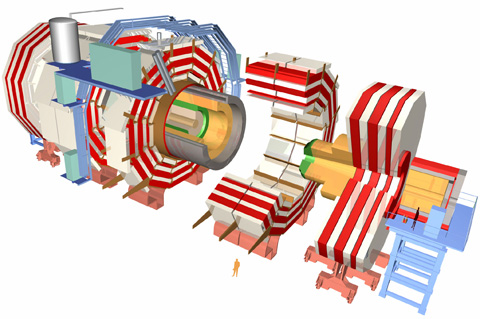
CMS setup

CMS detector

  • Size: 21 m long, 15 m wide and 15 m high.
  • Weight: 12 500 tonnes
  • Design: barrel plus end caps
  • Location: Cessy, France. See CMS in Google Earth. 

ATLAS - LHC experiment 1

ATLAS http://atlas.ch/


A Toroidal LHC ApparatuS

ATLAS is one of two general-purpose detectors at the LHC. It will investigate a wide range of physics, including the search for the Higgs boson, extra dimensions, and particles that could make up dark matter.

With the same goals in physics as CMS, ATLAS will record similar sets of measurements on the particles created in the collisions – their paths, energies, and their identities. However, the two experiments have adopted radically different technical solutions and designs for their detectors' magnet systems.

The main feature of the ATLAS detector is its enormous doughnut-shaped magnet system. This consists of eight 25‑m long superconducting magnet coils, arranged to form a cylinder around the beam pipe through the centre of the detector. During operation, the magnetic field is contained within the central cylindrical space defined by the coils.

More than 1700 scientists from 159 institutes in 37 countries work on the ATLAS experiment (March 2006).

ATLAS setup

ATLAS detector

  • Size: 46 m long, 25 m high and 25 m wide. The ATLAS detector is the largest volume particle detector ever constructed.
  • Weight: 7000 tonnes
  • Design: barrel plus end caps
  • Location: Meyrin, Switzerland. 

Boson 4: elusive Higgins Boson

The Higgs boson, also known as the God particle, is a hypothetical massive scalar elementary particlepredicted to exist by the Standard Model of particle physics. It is the only Standard Model particle not yet observed (with the exception of the Graviton), but plays a key role in explaining the origins of the mass of other elementary particles, in particular the difference between the massless photon and the relatively heavy W and Z bosons. Elementary particle masses, and the differences between electromagnetism (caused by the photon) and the weak force (caused by the W and Z bosons), are critical to many aspects of the structure of microscopic (and hence macroscopic) matter; thus, if it exists, the Higgs boson has an enormous effect on the world around us.


As of 2007, no experiment has directly detected the existence of the Higgs boson, but there is indirect evidence for it. The Higgs mechanism, which gives mass to vector bosons, was first theorized in 1964 byPeter Higgs, François Englert and Robert Brout, working from the ideas of Philip Anderson, and independently by G. S. Guralnik, C. R. Hagen, and T. W. B. Kibble [1]. Higgs proposed that the existence of a massive scalar particle could be a test of the theory, a remark added to his Physical Review letter [2] at the suggestion of the referee [3]. Steven Weinberg and Abdus Salam were the first to apply the Higgs mechanism to the electroweak symmetry breaking. The electroweak theory predicts a neutral particle whose mass is not far from the W and Z bosons.

Boson 3: Glouns holding the strong force

The gluon is a vector boson; like the photon, it has a spin of 1. While massive spin-1 particles have three polarization states, massless gauge bosons like the gluon have only two polarization states because gauge invariance requires the polarization to be transverse. In quantum field theory, unbroken gauge invariance requires that gauge bosons have zero mass (experiment limits the gluon's mass to less than a few MeV). The gluon has negative intrinsic parity and zero isospin. It is its own antiparticle.


Since gluons themselves carry color charge (again, unlike the photon which is electrically neutral), they participate in strong interactions. These gluon-gluon interactions constrain color fields to string-like objects called "flux tubes", which exert constant force when stretched. Due to this force, quarks are confined within composite particles called hadrons. This effectively limits the range of the strong interaction to 10-15 meters, roughly the size of an atomic nucleus.

Gluons also share this property of being confined within hadrons. One consequence is that gluons are not directly involved in the nuclear forces. The force mediators for these are other hadrons called mesons.

Although in the normal phase of QCD single gluons may not travel freely, it is predicted that there exist hadrons which are formed entirely of gluons — called glueballs. There are also conjectures about other exotic hadrons in which real gluons (as opposed to virtual ones found in ordinary hadrons) would be primary constituents. Beyond the normal phase of QCD (at extreme temperatures and pressures), quark gluon plasma forms. In such a plasma there are no hadrons; quarks and gluons become free particles


In particle physics, a glueball is a strongly interacting particle containing no valence quarks. It is composed entirely of gluons. Such a state is possible because gluons carry color chargeand experience the strong interaction. Glueballs are extremely difficult to identify in particle accelerators, because they mix with ordinary meson states.

Theoretical calculations show that glueballs should exist at energy ranges accessible with current collider technology. However, due to the mentioned difficulty, they have so far not been observed and identified with certainty.

Boson 2: W and Z bosons responsible for weak force

wo kinds of W bosons exist with +1 and −1 elementary units of electric charge; the W+ is the antiparticle of the W−. The Z boson (or Z) is electrically neutral and is its own antiparticle. All three particles are very short-lived with a mean life of about 3×10⁻²⁵  s.

These bosons are heavyweights among the elementary particles. With a mass of 80.4 GeV/c2  and 91.2 GeV/c2 , respectively, the W and Z particles are almost 100 times as massive as the proton—heavier than entire atoms of iron. The masses of these bosons are significant because they limit the range of the weak nuclear force. The electromagnetic force, by contrast, has an infinite range because its boson (the photon) is massless.

All three types have a spin of 1.

The emission of a W+ or W− boson can either raise or lower electric charge of the emitting particle by 1 unit, and alter the spin by 1 unit. At the same time a W boson can change the generation of the particle, for example changing a strange quark to an up quark. The Z boson cannot change either electric charge nor any other charges (like strangeness, charm, etc.), only spin and momentum, so it never changes the generation or flavor of the particle emitting it (see weak neutral current).

[edit]The weak nuclear force

The Feynman diagram for beta decay of a neutron into a proton, electron, and electron antineutrino via an intermediate heavy W boson
The Feynman diagram for beta decay of a neutroninto a proton, electron, and electron antineutrino via an intermediate heavy W boson

The W and Z bosons are carrier particles that mediate the weak nuclear force, much like the photon is the carrier particle for the electromagnetic force. The W boson is best known for its role in nuclear decay. Consider, for example, the beta decay of cobalt-60, an important process in supernova explosions.

6027Co → 6028Ni + e− + νe

This reaction does not involve the whole cobalt-60 nucleus, but affects only one of its 33 neutrons. The neutron is converted into aproton while also emitting an electron (called a beta particle in this context) and an antineutrino:

n0 → p+ + e− + νe

Again, the neutron is not an elementary particle but a composite of an up quark and two down quarks (udd). It is in fact one of the down quarks that interacts in beta decay, turning into an up quark to form a proton (uud). At the most fundamental level, then, the weak force changes the flavor of a single quark:

d → u + W−

which is immediately followed by decay of the W− itself:

W− → e− + νe

Being its own antiparticle, the Z boson has all zero quantum numbers. The exchange of a Z boson between particles, called a neutral current interaction, therefore leaves the interacting particles unaffected, except for a transfer of momentum. Unlike beta decay, the observation of neutral current interactions requires huge investments in particle accelerators and detectors, such as are available in only a few high-energy physics laboratories in the world.

Boson 1: Photon bearer of Electromagnetic force

In modern physics the photon is the elementary particle responsible for electromagnetic phenomena. It is the carrier of electromagnetic radiation of all wavelengths, including gamma rays, X-rays, ultraviolet light, visible light, infrared light, microwaves, and radio waves. The photon differs from many other elementary particles, such as the electron and the quark, in that it has zero rest mass;[3] therefore, it travels (in vacuum) at thespeed of light, c. Like all quanta, the photon has both wave and particle properties (“wave–particle duality”). As a wave, a single photon is distributed over space and shows wave-like phenomena, such as refraction by a lens and destructive interference when reflected waves cancel each other out; however, as a particle, it can only interact with matter by transferring the amount of energy

E = frac{hc}{lambda},

where h is Planck's constant, c is the speed of light, and λ is its wavelength. This is different from a classical wave, which may gain or lose arbitrary amounts of energy. For visible light the energy carried by a single photon would be around a tiny 4times10^{-19} joules; this energy is just sufficient to excite a single molecule in a photoreceptor cell of an eye,[citation needed] thus contributing to vision.[4]


Apart from energy a photon also carries momentum and has a polarization. It follows the laws of quantum mechanics, which means that often these properties do not have a well-defined value for a given photon. Rather, they are defined as a probability to measure a certain polarization, position, or momentum. For example, although a photon can excite a single molecule, it is often impossible to predict beforehand whichmolecule will be excited.


The above description of a photon as a carrier of electromagnetic radiation is commonly used by physicists. However, in theoretical physics, a photon can be considered as a mediator for any type of electromagnetic interactions, including magnetic fields and electrostatic repulsion between like charges.


The modern concept of the photon was developed gradually (1905–17) by Albert Einstein[5][6][7][8] to explain experimental observations that did not fit the classical wave model of light. In particular, the photon model accounted for the frequency dependence of light's energy, and explained the ability of matter and radiation to be in thermal equilibrium. Other physicists sought to explain these anomalous observations by semiclassical models, in which light is still described by Maxwell's equations, but the material objects that emit and absorb light are quantized. Although these semiclassical models contributed to the development of quantum mechanics, further experiments proved Einstein's hypothesis that light itself is quantized; the quanta of light are photons.


The photon concept has led to momentous advances in experimental and theoretical physics, such as lasers,Bose–Einstein condensation, quantum field theory, and the probabilistic interpretation of quantum mechanics. According to the Standard Model of particle physics, photons are responsible for producing allelectric and magnetic fields, and are themselves the product of requiring that physical laws have a certainsymmetry at every point in spacetime. The intrinsic properties of photons — such as charge, mass and spin— are determined by the properties of this gauge symmetry.


The concept of photons is applied to many areas such as photochemistry, high-resolution microscopy, andmeasurements of molecular distances. Recently, photons have been studied as elements of quantum computers and for sophisticated applications in optical communication such as quantum cryptography.