BANGALORE: Indian scientists have developed path-breaking technology that has the potential to increase the range of missiles and satellite launch vehicles by at least 40%, a member of the team which achieved the technological breakthrough said.
India’s longest-range missile, Agni III, is capable of hitting targets 3,500 km away and the new technology could boost its range to 4,900 km. The enhanced range is made possible by adding a special-purpose coating of chromium metal to the blunt nose cone of missiles and launch vehicles, G Jagadeesh, an assistant professor at the Indian Institute of Science (IISc) here said.
IISc, which is in celebrating its centenary this year, has applied for an international patent for the technology.
“Objects such as missiles fly at hypersonic velocities which are more than five times the speed of sound and encounter atmospheric drag because of friction. The chromium coating works by adding temporary heat and pushing the stagnating gas away to create an easier path,” Mr Jagadeesh said. Laboratory experiments have shown that atmospheric drag because of the coating fell by 47% and Mr Jagadeesh said a “conservative estimate” was that this would result in range going up at least 40%.
The findings of the team—which also includes Vinayak Kulkarni of IIT-Guwahati and G M Hegde, E Arunan and K P J Reddy of IISc—have been reported in the latest issue of the Physics of Fluids journal published by the American Institute of Physics.
The breakthrough also has potential to help avert problems of the type which led to break up in 2003 of the American space shuttle Columbia when it was re-entering the earth’s atmosphere. The disaster was caused by damage to the shuttle’s thermal protection system, killing seven crew members, including astronaut of Indian origin Kalpana Chawla.
The special-purpose coating in place of the tiles and panels which now protect orbiters against extreme heat during re-entry into the atmosphere is seen as distinct possibility.
“The coating evaporates once the object has re-entered the atmosphere. This novel method is path-breaking because additional energy is not required to reduce drag; objects which travel into space need to carry a much lower fuel load,” he said.
Showing posts with label Future. Show all posts
Showing posts with label Future. Show all posts
Wednesday, September 10, 2008

Thursday, September 4, 2008
More Category 4 and Category 5 hurricanes than earlier
Strongest Storms Grow Stronger Yet, Study Says
new_york_times:http://www.nytimes.com/2008/09/04/science/04cyclone.html
By KENNETH CHANG
Published: September 3, 2008
A new study finds that the strongest of hurricanes and typhoons have become even stronger over the last two and a half decades, adding grist to the contentious debate over whether global warming has already made storms more destructive.
Skip to next paragraph
Multimedia
Graphic
Strongest Cyclones Growing Stronger
Related
Dot Earth: Hurricane Expert Reassesses Link to Warming (April 12, 2008)
THE OUTLOOK: Storms Vary With Cycles, Experts Say (August 30, 2005)
A Conversation with Kerry Emanuel: With Findings on Storms, Centrist Recasts Warming Debate (January 10, 2006)
2 Studies Link Global Warming to Greater Power of Hurricanes (May 31, 2006)
Will Warming Lead to a Rise in Hurricanes? (May 29, 2007)
Times Topics: Hurricanes and Tropical Storms
Web Link
The increasing intensity of the strongest tropical cyclones (Nature)
RSS Feed
#articleInline ul {
margin: .5em 0 1.2em 0;
}
#articleInline ul li {
margin-bottom: .5em;
padding: 0;
background-image: none;
font-size: 81.5%;
font-family: Arial, Helvetica, sans-serif;
line-height: 1.4em;
}
#articleInline li a {
padding: .2em 0 .2em 4.5em;
background: transparent url(http://graphics8.nytimes.com/images/global/icons/rss.gif) no-repeat 0 0;
}
Get Science News From The New York Times »
“I think we do see a climate signal here,” said James B. Elsner, a professor of geography at Florida State University who is the lead author of the paper, being published in Thursday’s issue of the journal Nature.
The study, which also found that more typical, less powerful tropical storms had not become stronger over the 26-year period studied, is consistent with other researchers’ hurricane models, Dr. Elsner said.
With oceans expected to continue warming, “one would expect more 4s and 5s,” he said of Category 4 and Category 5 hurricanes, those with maximum sustained winds of at least 131 miles per hour.
About 90 tropical cyclone storms form each year around the world. In the Atlantic, the stronger ones, with winds of at least 74 m.p.h., are hurricanes; the equivalents in the Pacific and Indian Oceans are typhoons. Ten named storms have formed in the Atlantic this hurricane season, which continues to the end of November.
Heat from the warming oceans will provide more energy to spin up hurricanes and typhoons, but the changing climate could also heighten conditions like wind shear — winds blowing at different speeds and different directions at different altitudes — that tend to tear a storm apart.
Because of these environmental factors, most storms fall far short of their maximum possible intensity. But Dr. Elsner, along with Thomas H. Jagger, a postdoctoral researcher at Florida State, and James P. Kossin, a research scientist at the University of Wisconsin-Madison, reasoned that warmer waters increased the possible intensity and that storms that develop in ideal conditions might have become stronger.
Having examined satellite data from 1981 through 2006, a period in which sea surface temperature rose to 83.3 degrees Fahrenheit from 82.8 degrees, they concluded that the highest wind speeds of the strongest storms averaged 156 m.p.h. in 2006, up from 140 m.p.h. hour in 1981. The increases in cyclone intensity were greatest in the Atlantic and Indian Oceans.
Because the data came from one set of satellites, the scientists avoided some of the calibration difficulties that had troubled earlier studies.
“This study offers definitive evidence that there are more of the very strongest hurricanes around the world, even though the total number of storms globally shows hardly any trend,” said Kerry A. Emanuel, a professor of atmospheric science at the Massachusetts Institute of Technology, who suggested in 2005 that global warming had already intensified cyclones.
Christopher W. Landsea, science and operations manager at the National Hurricane Center, who has been skeptical of the connection, said the statistical methodology in the new study was excellent. But Dr. Landsea questioned the underlying data, particularly corrections for data taken from the Indian Ocean before 1997, when there were fewer satellites observing the storms.
He also said that the conclusions might have been skewed because the starting point of the data, 1981, coincided with a relatively quiet period of Atlantic hurricane activity, whereas the ending point, 2006, coincided with an active period that began around 1995.
“The paper has some elegantly calculated statistics, but these are generated on data that are not, in my opinion, reliable for examining how the strongest tropical cyclones have changed around the world,” Dr. Landsea said.
Thomas R. Knutson of the Geophysical Fluid Dynamics Laboratory at Princeton said the data involved too short a period to draw long-term conclusions.
“One is left with a very suggestive result and a very interesting result,” Dr. Knutson said, “but it’s not a definitive smoking gun for a greenhouse warming signal on hurricanes.”
Sunday, August 24, 2008
10 Questions, and Answers, About Evolution
“Ten questions to ask your biology teacher about evolution,” a document by Jonathan Wells, a senior fellow at the Discovery Institute, a Seattle-based group that advocates intelligent design, aims to highlight the weaknesses in evolutionary theory. Here are his questions, along with responses compiled by the National Center for Science Education. More questions can be found on Dr. Wells’s site, http://www.iconsofevolution.com/ More information about biological evolution can be found at http://nationalacademies.org/evolution/.
Related
A Teacher on the Front Line as Faith and Science Clash (August 24, 2008)
1. Origin of life. Why do textbooks claim that the 1953 Miller-Urey experiment shows how life’s building blocks may have formed on the early Earth — when conditions on the early Earth were probably nothing like those used in the experiment, and the origin of life remains a mystery?
N.C.S.E. answer: Because evolutionary theory works with any model of the origin of life on Earth, how life originated is not a question about evolution. Textbooks discuss the 1953 studies because they were the first successful attempt to show how organic molecules might have been produced on the early earth. When modern scientists changed the experimental conditions to reflect better knowledge of the earth’s early atmosphere, they were able to produce most of the same building blocks. Origin-of-life remains a vigorous area of research.
2. Darwin’s tree of life. Why don’t textbooks discuss the “Cambrian explosion,” in which all major animal groups appear together in the fossil record fully formed, instead of branching from a common ancestor — thus contradicting the evolutionary tree of life?
A. Fish, amphibians, reptiles, birds, and mammals all are post-Cambrian. We would recognize very few of the Cambrian organisms as “modern”; they’re in fact at the roots of the tree of life, showing the earliest appearances of some key features of groups of animals - but not all features and not all groups. Researchers are linking these Cambrian groups using not only fossils but also data from developmental biology.
3. Homology. Why do textbooks define homology as similarity due to common ancestry, then claim that it is evidence or common ancestry — a circular argument masquerading as scientific evidence?
A: The same anatomical structure (such as a leg or an antenna) in two species may be similar because it was inherited from a common ancestor (homology) or because of similar adaptive pressure (convergence) . Homology of structures across species is not assumed, but tested by the repeated comparison of numerous features that do or do not sort into successive clusters. Homology is used to test hypotheses of degrees of relatedness. Homology is not “evidence” for common ancestry: common ancestry is inferred based on many sources of information, and reinforced by the patterns of similarity and dissimilarity of anatomical structures.
4. Vertebrate embryos. Why do textbooks use drawings of similarities in vertebrate embryos as evidence for their common ancestry — even though biologists have known for over a century that vertebrate embryos are not most similar in their early stages, and the drawings are faked?
A: Twentieth-century and current embryological research confirms that early stages (if not the earliest) of vertebrate embryos are more similar than later ones; the more recently species shared a common ancestor, the more similar their embryological development. Thus cows and rabbits - mammals - are more similar in their embryological development than either is to alligators. Cows and antelopes are more similar in their embryology than either is to rabbits, and so on. The union of evolution and developmental biology — “evo-devo” — is one of the most rapidly growing biological fields. “Faked” drawings are not relied upon: there has been plenty of research in developmental biology since Haeckel (long-discredited drawings that were used in textbooks 20 years ago) and in fact, hardly any textbooks feature Haeckel’s drawings, as claimed.
5. Archaeopteryx. Why do textbooks portray this fossil as the missing link between dinosaurs and modern birds — even though modern birds are probably not descended from it, and its supposed ancestors do not appear until millions of years after it?
A: The notion of a “missing link” is an out-of-date misconception about how evolution works. Archaeopteryx (and other feathered fossils) shows how a branch of reptiles gradually acquired both the unique anatomy and flying adaptations found in all modern birds. It is a transitional fossil. These fossils are not direct ancestors of modern birds but relatives, and, as everyone knows, your uncle can be younger than you!
6. Peppered moths. Why do textbooks use pictures of peppered moths camouflaged on tree trunks as evidence for natural selection — when biologists have known since the 1980s that the moths don’t normally rest on tree trunks, and all the pictures have been staged?
Related
A Teacher on the Front Line as Faith and Science Clash (August 24, 2008)
A: These pictures are illustrations used to demonstrate a point - the advantage of protective coloration to reduce the danger of predation. The pictures are not the scientific evidence used to prove the point in the first place. Compare this illustration to the well-known re-enactments of the Battle of Gettysburg. Does the fact that these re-enactments are staged prove that the battle never happened? The peppered moth photos are the same sort of illustration, not scientific evidence for natural selection.
7. Darwin’s finches. Why do textbooks claim that beak changes in Galapagos finches during a severe drought can explain the origin of species by natural selection — even though the changes were reversed after the drought ended, and no net evolution occurred?
A: Textbooks present the finch data to illustrate natural selection: that populations change their physical features in response to changes in the environment. The finch studies exquisitely documented how the physical features of an organism can affect its success in reproduction and survival, and that such changes can take place more quickly than was realized. That new species did not arise within the duration of the study hardly challenges evolution!
8. Mutant fruit flies. Why do textbooks use fruit flies with an extra pair of wings as evidence that DNA mutations can supply raw materials for evolution — even though the extra wings have no muscles and these disabled mutants cannot survive outside the laboratory?
A: In the very few textbooks that discuss four-winged fruit flies, they are used as an illustration of how genes can reprogram parts of the body to produce novel structures, thus indeed providing “raw material” for evolution. This type of mutation produces new structures that become available for further experimentation and potential new uses. Even if not every mutation leads to a new evolutionary pathway, the flies are a vivid example of one way mutation can provide variation for natural selection to work on.
9. Human origins. Why are artists’ drawings of ape-like humans used to justify materialistic claims that we are just animals and our existence is a mere accident — when fossil experts cannot even agree on who our supposed ancestors were or what they looked like?
A: Drawings of humans and our ancestors illustrate the general outline of human ancestry, about which there is considerable agreement, even if new discoveries continually add to the complexity of the account. The notion that such drawings are used to “justify materialistic claims” is not borne out by an examination of textbook treatments of human evolution.
10. Evolution a fact? Why are we told that Darwin’s theory of evolution is a scientific fact — even though many of its claims are based on misrepresentations of the facts?
A: In the last century, some of what Darwin originally proposed has been augmented by more modern scientific understanding of inheritance (genetics), development, and other processes that affect evolution. What remains unchanged is that similarities and differences among living things on Earth over time and space display a pattern that is best explained by evolutionary theory.
Wednesday, August 20, 2008
Chandrayaan-I set for launch later this year: Kasturirangan
India's maiden moon mission Chandrayaan-I is set for a late October or an early December launch, noted space scientist and former Isro chairman Krishnaswamy Kasturirangan said.
Also Read
News Now
Paper
Specials
- RCom, Bharti help Sensex break five-day losing streak
- A modern electoral tradition: selling votes on eBay
- Grasim foresees 5% dip in its margins
- Idea launches operations in Mumbai, plans to invest Rs 800 crore
- Govt clears first tranche of fertilisers subsidy
- Air fare revision unlikely next month
More
The spacecraft, which will carry five Indian and six international experiments, has been assembled and undergoing a series of tests, he said.
The unmanned mission, which will orbit the moon for two years, is expected to be launched in by late October or early December by Polar Satellite Launch Vehicle (PSLV), said Kasturirangan, a Rajya Sabha member who is also the Director of National Institute for Advances Sciences, Bangalore.
He was speaking at a function here last evening to release a book titled, "Destination Moon: India's Quest for the Moon and Beyond" authored by science writers Pallava Bagla and Subhadra Menon.
The spacecraft, which is no bigger than a typical office cubicle, is currently undergoing tests for its ability to handle the extreme thermal and vacuum environment experienced in a lunar orbit. These assessments will be followed by vibration and acoustic tests.
"The thermovac test will continue about three weeks which takes us to a late October launch otherwise it would be in December as satellite launches do not take place in November, a cyclone season," Kasturirangan said.
Meanwhile, India has already begun work on the next lunar mission in which space scientists plan to land a rover on the surface of the moon to collect rock and dust samples.
Chandrayaan-II will be developed as a joint venture project with Russia and a Memorandum of Understanding has been signed in that regard.
Saturday, August 2, 2008
Arctic climate is changing fast and will continue to happen fast
This isn't Global warming, just the artic climate is reversing and it is one way process. The ice sheets are breaking apart. Artic environment is no longer the process of Ice growing, to the contratary it is ice breaking.
July 30, 2008—A chunk of ice spreading across 7 square miles (18 square kilometers) has broken off a Canadian ice shelf in the Arctic, scientists say.
The sheet broke away last week from the Ward Hunt Ice Shelf off the north coast of Ellesmere Island in Canada's far north. Large ice segments—including this 1.5-square-mile (4-square-kilometer) chunk, above—were seen drifting near the ice shelf. A crack in the shelf was first spotted in 2002 and a survey this spring found a network of fissures.
Gary Stern, co-leader of an international research program on sea ice, said it's the same story all around the Arctic.
Speaking from the Coast Guard icebreaker Amundsen in Canada's north, Stern said he hadn't seen any ice in weeks.
"Nobody on the ship is surprised anymore," Stern said. "We've been trying to get the word out for the longest time now that things are happening fast and they're going to continue to happen fast."
Source: http://news.nationalgeographic.com/news/2008/07/080730-arctic-photo-AP.html
Friday, August 1, 2008
Water found in Mars
"We have water," said William Boynton of the University of Arizona, lead scientist for the Thermal and Evolved-Gas Analyzer, or TEGA. "We've seen evidence for this water ice before in observations by the Mars Odyssey orbiter and in disappearing chunks observed by Phoenix last month, but this is the first time Martian water has been touched and tasted."
Mars has confirmed the water can exist in another planet.
Time for ISRO to play catch game before China, USA and EU amke the Mars their next stop over.
With enticing results so far and the spacecraft in good shape, NASA also announced operational funding for the mission will extend through Sept. 30. The original prime mission of three months ends in late August. The mission extension adds five weeks to the 90 days of the prime mission.
The soil sample came from a trench approximately 2 inches deep. When the robotic arm first reached that depth, it hit a hard layer of frozen soil. Two attempts to deliver samples of icy soil on days when fresh material was exposed were foiled when the samples became stuck inside the scoop. Most of the material in Wednesday's sample had been exposed to the air for two days, letting some of the water in the sample vaporize away and making the soil easier to handle. "Mars is giving us some surprises," said Phoenix principal investigator Peter Smith of the University of Arizona. "We're excited because surprises are where discoveries come from. One surprise is how the soil is behaving. The ice-rich layers stick to the scoop when poised in the sun above the deck, different from what we expected from all the Mars simulation testing we've done. That has presented challenges for delivering samples, but we're finding ways to work with it and we're gathering lots of information to help us understand this soil."
Since landing on May 25, Phoenix has been studying soil with a chemistry lab, TEGA, a microscope, a conductivity probe and cameras. Besides confirming the 2002 finding from orbit of water ice near the surface and deciphering the newly observed stickiness, the science team is trying to determine whether the water ice ever thaws enough to be available for biology and if carbon-containing chemicals and other raw materials for life are present. The mission is examining the sky as well as the ground. A Canadian instrument is using a laser beam to study dust and clouds overhead. "It's a 30-watt light bulb giving us a laser show on Mars," said Victoria Hipkin of the Canadian Space Agency. A full-circle, color panorama of Phoenix's surroundings also has been completed by the spacecraft. "The details and patterns we see in the ground show an ice-dominated terrain as far as the eye can see," said Mark Lemmon of Texas A&M University, lead scientist for Phoenix's Surface Stereo Imager camera. "They help us plan measurements we're making within reach of the robotic arm and interpret those measurements on a wider scale." The Phoenix mission is led by Smith at the University of Arizona with project management at NASA's Jet Propulsion Laboratory in Pasadena, Calif., and development partnership at Lockheed Martin in Denver. International contributions come from the Canadian Space Agency; the University of Neuchatel, Switzerland; the universities of Copenhagen and Aarhus in Denmark; the Max Planck Institute in Germany; and the Finnish Meteorological Institute.
Source: http://www.nasa.gov/mission_pages/phoenix/news/phoenix-20080731.html
Tuesday, July 29, 2008
What are cloud computing testbeds?
IBM Cloud Computing and Autonomic Computing: IBM first introduced the term "Autonomic Computing" in 2001 and issued a Grand Challenge to the industry to build computer systems that regulate themselves much in the same way the autonomic nervous system regulates and protects the human body. Autonomic Computing was unveiled as a solution to combat the rising complexity of managing advanced computer systems. IBM has since integrated autonomic capabilities in over 500 product features into more than 100 distinct products and services. With Autonomic Computing, the company has focused on simplifying data center operations with virtualization, provisioning, databases, maintenance, energy management, security and other areas.
The word green soon embodied the word "word cloud". efficiency, energy or overall ROI with an idea of 1000+ servers working to produce the best results for a human crowd working across. The relatedness of cost is more important with cloud networks as freeware is considered more desirable. Also the usage of latest technologies at a lower cost is the ultimate goal. It is like perestroika in the communist regime.
Lets break down the game as why testbed environments are getting popular and in case of amazon and Google,even Internet industrial use.
How Amazon cashes in on its Cloud http://www.it-analysis.com/blogs/Judith_Hurwitz/2008/5/how_amazon_cashes_in_on_its_cloud.html clearly mentions how Amazon is able to scale on hardware growth which its customers will find hard to match like 10GB to 100 TB in a month . Amazon offers cheaper more reliable options by virtualization of servers. Also Amazon gets the best services and applications for the customer to use. The cloud theory breaks down traditional paradigms of world computing.
Google by offering free applications like gmail/picassa has taken the cloud theory beyond the natural office which debunks even free OS offers like linux coupling with Jboss. The much touted web browser can be even vitalized using applications like citrix or even invoking virtual desktops with technologies like Logmein and TeamPlayer.
So what essentially is a cloud is defined by industrial preference to use the servers and reorganization of servers for the same. for example cuil boasts of a huge database of index servers which seems less efficient than google index database. However cuil industrial use may beat google for category based search and cuil will co-exist with google for high end searches.
Internet clouds are a interlinked clouds with millions of servers and active trillions of clients requesting soap, on demand services from multiple gadgets. The ability to provide results in cost efficient way is the testbed cloud server maze testing. Example google stores its picassa servers on virtualization for hardware reasons for active accounts only would be a test ingredient for a cloud server arrangement. example google.co.uk could host it instead of cloud google.co.in

A rudimentary test cloud bed would be based on on demand applications for the internet with analysis of emerging applications with focus of backward compatibility with the old world internet

HP, Yahoo, Intel Launch Cloud Computing Test Bed have launched a new cloud computing research initiative called the Cloud Computing Test Bed. Users will be able to build and launch new applications on the platform.
It’s being described as “a globally distributed, Internet-scale testing environment designed to encourage research on the software, data center management and hardware issues associated with cloud computing at a larger scale than ever before.” Other partners include the Infocomm Development Authority of Singapore (IDA) (which is distinct from the MDA, I believe, which is unfortunate), the University of Illinois at Urbana-Champaign, and the Karlsruhe Institute of Technology (KIT) in Germany:
Governments have also launched non internet cloud beds like the e-governance initiatives of Indian government with automatic ballot boxes, e-fling taxes, pan cards. It makes more sense in a low cost cloud network to achieve results of the numerous application and the usage can be better patronized.
The word green soon embodied the word "word cloud". efficiency, energy or overall ROI with an idea of 1000+ servers working to produce the best results for a human crowd working across. The relatedness of cost is more important with cloud networks as freeware is considered more desirable. Also the usage of latest technologies at a lower cost is the ultimate goal. It is like perestroika in the communist regime.
Lets break down the game as why testbed environments are getting popular and in case of amazon and Google,even Internet industrial use.
How Amazon cashes in on its Cloud http://www.it-analysis.com/blogs/Judith_Hurwitz/2008/5/how_amazon_cashes_in_on_its_cloud.html clearly mentions how Amazon is able to scale on hardware growth which its customers will find hard to match like 10GB to 100 TB in a month . Amazon offers cheaper more reliable options by virtualization of servers. Also Amazon gets the best services and applications for the customer to use. The cloud theory breaks down traditional paradigms of world computing.
Google by offering free applications like gmail/picassa has taken the cloud theory beyond the natural office which debunks even free OS offers like linux coupling with Jboss. The much touted web browser can be even vitalized using applications like citrix or even invoking virtual desktops with technologies like Logmein and TeamPlayer.
So what essentially is a cloud is defined by industrial preference to use the servers and reorganization of servers for the same. for example cuil boasts of a huge database of index servers which seems less efficient than google index database. However cuil industrial use may beat google for category based search and cuil will co-exist with google for high end searches.
Internet clouds are a interlinked clouds with millions of servers and active trillions of clients requesting soap, on demand services from multiple gadgets. The ability to provide results in cost efficient way is the testbed cloud server maze testing. Example google stores its picassa servers on virtualization for hardware reasons for active accounts only would be a test ingredient for a cloud server arrangement. example google.co.uk could host it instead of cloud google.co.in
A rudimentary test cloud bed would be based on on demand applications for the internet with analysis of emerging applications with focus of backward compatibility with the old world internet
HP, Yahoo, Intel Launch Cloud Computing Test Bed have launched a new cloud computing research initiative called the Cloud Computing Test Bed. Users will be able to build and launch new applications on the platform.
It’s being described as “a globally distributed, Internet-scale testing environment designed to encourage research on the software, data center management and hardware issues associated with cloud computing at a larger scale than ever before.” Other partners include the Infocomm Development Authority of Singapore (IDA) (which is distinct from the MDA, I believe, which is unfortunate), the University of Illinois at Urbana-Champaign, and the Karlsruhe Institute of Technology (KIT) in Germany:
Governments have also launched non internet cloud beds like the e-governance initiatives of Indian government with automatic ballot boxes, e-fling taxes, pan cards. It makes more sense in a low cost cloud network to achieve results of the numerous application and the usage can be better patronized.
Thursday, July 24, 2008
1971 Apollo Moonwalk astronaut claims aliens are real!
Aliens do exist and have contacted humans on earth, according to top astronaut Dr Edgar Mitchell who was the sixth man on the moon.
The truth has been hidden by governments for more than 60 years, the moon walker said.
He claims he is lifting the lid on a conspiracy to keep aliens a secret.

Dr Mitchell, who was on Apollo 14 in 1971, said he was aware of many UFO visits to Earth during his career with NASA but each one was covered up.
The 77-year-old claims the space agency made contact with aliens, describing the beings as 'little people who look strange to us.'
He said supposedly real-life ET's were similar to the traditional image of a small frame, large eyes and head.
He claimed our technology is 'not nearly as sophisticated' as theirs and warned 'we would be been gone by now' had the aliens been hostile.
Dr Mitchell is joint record holder for the longest ever moon walk, at nine hours and 17 minutes.
During a radio interview he said: 'I happen to have been privileged enough to be in on the fact that we've been visited on this planet and the UFO phenomena is real.
'It's been well covered up by all our governments for the last 60 years or so, but slowly it's leaked out and some of us have been privileged to have been briefed on some of it.
'I've been in military and intelligence circles, who know that beneath the surface of what has been public knowledge, yes - we have been visited. Reading the papers recently, it's been happening quite a bit.'
Dr Mitchell has a Bachelor of Science degree in aeronautical engineering and a Doctor of Science degree in Aeronautics and Astronautics.

Officials from NASA said it did not track UFOs and wasn't involved in a cover up. A spokesman added: 'Dr Mitchell is a great American, but we do not share his opinions on this issue.'
The truth has been hidden by governments for more than 60 years, the moon walker said.
He claims he is lifting the lid on a conspiracy to keep aliens a secret.
Dr Mitchell, who was on Apollo 14 in 1971, said he was aware of many UFO visits to Earth during his career with NASA but each one was covered up.
The 77-year-old claims the space agency made contact with aliens, describing the beings as 'little people who look strange to us.'
He said supposedly real-life ET's were similar to the traditional image of a small frame, large eyes and head.
He claimed our technology is 'not nearly as sophisticated' as theirs and warned 'we would be been gone by now' had the aliens been hostile.
Dr Mitchell is joint record holder for the longest ever moon walk, at nine hours and 17 minutes.
During a radio interview he said: 'I happen to have been privileged enough to be in on the fact that we've been visited on this planet and the UFO phenomena is real.
'It's been well covered up by all our governments for the last 60 years or so, but slowly it's leaked out and some of us have been privileged to have been briefed on some of it.
'I've been in military and intelligence circles, who know that beneath the surface of what has been public knowledge, yes - we have been visited. Reading the papers recently, it's been happening quite a bit.'
Dr Mitchell has a Bachelor of Science degree in aeronautical engineering and a Doctor of Science degree in Aeronautics and Astronautics.
Officials from NASA said it did not track UFOs and wasn't involved in a cover up. A spokesman added: 'Dr Mitchell is a great American, but we do not share his opinions on this issue.'
Wednesday, July 23, 2008
Theories of Learning "Digitalinuisim"
Intenet, Mobile, Wireless, Television, Radio, Waves, Google, Social Network symbolize connectivisim.
Int the article , the theory of digital age http://www.elearnspace.org/Articles/connectivism.htm, the conclusion says
"Conclusion:
The pipe is more important than the content within the pipe. Our ability to learn what we need for tomorrow is more important than what we know today. A real challenge for any learning theory is to actuate known knowledge at the point of application. When knowledge, however, is needed, but not known, the ability to plug into sources to meet the requirements becomes a vital skill. As knowledge continues to grow and evolve, access to what is needed is more important than what the learner currently possesses.
Connectivism presents a model of learning that acknowledges the tectonic shifts in society where learning is no longer an internal, individualistic activity. How people work and function is altered when new tools are utilized. The field of education has been slow to recognize both the impact of new learning tools and the environmental changes in what it means to learn. Connectivism provides insight into learning skills and tasks needed for learners to flourish in a digital era."
To expand the meaning of conencting exponential growing sciences, the art of understanding theories must be crystallized. An interesting blog http://www.learning-theories.com/ exactly pinpoints. The connectivism theory is related to Discovery Learning under Paradigm: Constructivism
http://www.learning-theories.com/discovery-learning-bruner.html or
to paradigm Behaviourism
http://www.learning-theories.com/behaviorism.html
a) Classical example would be the google trends in India that I use to understand digital age.
I am constructively understanding the Behaviour of Internet at a point when I am free.
b) Event let Behaviour in mass communications places like airports or olympics
I also coin a new theory for Digitalinuisim which is like Humanistic theory
http://www.learning-theories.com/category/humanist-theories . The fullfilment of The digital versions of digital ideas/philosophies and converging the learning to accomodate the digital manifestations of the technology.
1) Digitalinuisim goes step further in multi pronged learning and with practical possibilities or implies future possibilities to achieve the same
2) In its pursuit, Digitalinuisim works like a multiplier effect ( ex- Code Jam by Google) which used the word Code and Jam which were two different learning instruments in their own right to propogate a new freeware language especially the google Python.
3) Information is growing, replicating in all unnecessary forms with blogs, mobile sms, mms, u tubes, emails. Not all information is design based learning
http://www.learning-theories.com/design-based-research-methods.html
4) Digitalinuisim is the method of getting the mixing the behaviour, winners, losers, and then creating the context to feed into social Humanistic behaviour
Example1:
1) Voting machines in India -> Voter cards -> Voting -> electorate
2) Pan cards-> efiling in India -> Tax returns -> Tax paying Indian population
Thus the mix of electorate and Tax paying Indian population needs a content which are determined by Pan cards and Voter cards. The ability of Digitalinuisim to mix the two different behaviourial processes is the power of miss mash. It wont be funny if a Indian electorate wants to file Tax returns using a Votercard. Thus Digitalinuisimfeeds into a new digital technology that is convergence of two processes and connects them , multipronged.
Example 2: Thus we have the All Bangalore One card which every Bangalore person must hold. Here Digitalinuisimcombines Identity process with Paying process similar to Suica of Japan.
The multipronged of behaviour assumes money is digitalized in cards and also the new behaviour of humans to use one digital card with two processes. It also assumes the parallel world thus complicating the Design based theory.
Welcome to the new world of "Digitalinuisim"
Wednesday, July 16, 2008
India's booming business of religion
There are many web sites that list all kinds of jobs in the commercial world. Still, one may be surprised to learn that there is one such job site meant only for Sikh priests. Gurdwara.com is the brainchild of a Singapore-based Sikh, Amritpal Singh, who spotted a smart business opportunity in view of the fact that despite the millions of dollars spent on building gurdwaras – places of worship for Sikhs – all over the world, there were few knowledgeable experts to run them or preach in them.
Source: http://upiasiaonline.com/Society_Culture/2008/07/02/indias_booming_business_of_religion/2083/
Source: http://upiasiaonline.com/Society_Culture/2008/07/02/indias_booming_business_of_religion/2083/
Monday, July 14, 2008
What’s Beyond 3G?
Operators are eyeing the future, even as they continue to roll out 3G networks. With the apple introduction of 3G phones, the demand for 3G+ services, essentially broadband with higher speeds and greater user usability will be far more seen in the future. More so in countries like India where bandwidth allocation and frequency regulation is a constant battle among network providers and regulatory areas.
 The evolution from voice-only functions to need for users to work with multimedia services have slowly converged. The demand is defined in three stages.
a) Network carriers preferences
b) Mobile manufacturer prefer
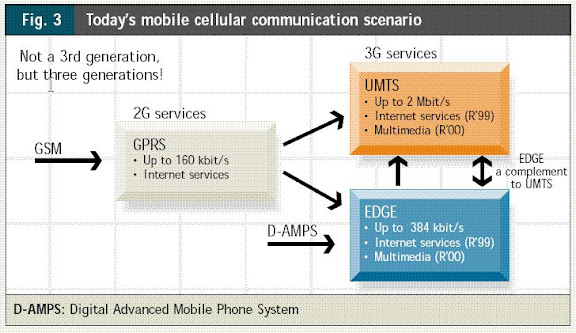 GSM also called 2G is based on time division multiple access evolve dinto GPRS also called 2.5G. It provides moderate speed data transfer, by using unused (TDMA) channels . GPRS can be used for services such as Wireless Application Protocol (WAP) access, Short Message Service (SMS), Multimedia Messaging Service (MMS), and for Internet communication services such as email and World Wide Web access. GPRS data transfer is typically charged per megabyte of traffic transferred, while data communication via traditional circuit switching is billed per minute of connection time, independent of whether the user actually is using the capacity or is in an idle state. GPRS is a best-effort packet switched service, as opposed to circuit switching, where a certain Quality of Service (QoS) is guaranteed during the connection for non-mobile users.
Circuit Switched Data (CSD) is the original form of data transmission developed for the time division multiple access (TDMA)-based mobile phone systems like Global System for Mobile Communications (GSM). CSD uses a single radio time slot to deliver 9.6 kbit/s data transmission to the GSM Network and Switching Subsystem where it could be connected through the equivalent of a normal modem to the Public Switched Telephone Network (PSTN) allowing direct calls to any dial-up service.
High-Speed Circuit-Switched Data (HSCSD), is an enhancement to Circuit Switched Data, the original data transmission mechanism of the GSM mobile phone system, four times faster than GSM, with data rates up to 38.4 kbit/s. One innovation in HSCSD is to allow different error correction methods to be used for data transfer. The original error correction used in GSM was designed to work at the limits of coverage and in the worst case that GSM will handle. This means that a large part of the GSM transmission capacity is taken up with error correction codes. HSCSD provides different levels of possible error correction which can be used according to the quality of the radio link. This means that in the best conditions 14.4 kbit/s can be put through a single time slot that under CSD would only carry 9.6 kbit/s, for a 50% improvement in throughput.
HSCSD is also an option in EDGE and UMTS systems where packet data transmission rates are much higher. In the UMTS system the advantages of HSCSD over packet data are even lower since the UMTS radio interface has been specifically designed to support high bandwidth, low latency packet connections. This means that the primary reason to use HSCSD in this environment would be access to legacy dial up systems.
Enhanced Data Rates for GSM Evolution. EDGE is generally classified as 2.75G . EDGE can be used for any packet switched application, such as an Internet connection. High-speed data applications such as video services and other multimedia benefit from EGPRS' increased data capacity. EDGE/EGPRS is implemented as a bolt-on enhancement for 2G and 2.5G GSM and GPRS networks, making it easier for existing GSM carriers to upgrade to it. EDGE/EGPRS is a superset to GPRS and can function on any network with GPRS deployed on it, provided the carrier implements the necessary upgrade. Athough EDGE requires no hardware or software changes to be made in GSM core networks, base stations must be modified. EDGE compatible transceiver units must be installed and the base station subsystem needs to be upgraded to support EDGE. New mobile terminal hardware and software is also required to decode/encode the new modulation and coding schemes and carry the higher user data rates to implement new services.
EDGE Evolution improves on EDGE in a number of ways. Latencies are reduced by lowering the Transmission Time Interval by half (from 20 ms to 10 ms). Bit rates are increased up to 1 MBit/s peak speed and latencies down to 100 ms using dual carriers, higher symbol rate and higher-order modulation (32QAM and 16QAM instead of 8-PSK), and turbo codes to improve error correction. And finally signal quality is improved using dual antennas. An EDGE Evolution terminal or network can support some of these improvements, or roll them out in stages.
EDGE is actively supported by GSM operators in North America. Some GSM operators elsewhere viewed UMTS the ultimate upgrade path and either planned to skip EDGE altogether or use it outside the UMTS coverage area. However, the high cost and slow uptake of UMTS have resulted in fairly common support for EDGE in the global GSM/GPRS market
Alternatively , Code division multiple access (CDMA) is a channel access method utilized by various radio communication technologies
W-CDMA (Wideband Code Division Multiple Access) is a type of 3G cellular network. W-CDMA is the higher speed transmission protocol used in the Japanese FOMA system and in the UMTS system, a third generation follow-on to the 2G GSM networks deployed worldwide.
Universal Mobile Telecommunications System (UMTS) is one of the third-generation (3G) cell phone technologies, which is also being developed into a 4G technology. Currently, the most common form of UMTS uses W-CDMA as the underlying air interface. It is standardized by the 3GPP, and is the European answer to the ITU IMT-2000 requirements for 3G cellular radio systems. To differentiate UMTS from competing network technologies, UMTS is sometimes marketed as 3GSM, emphasizing the combination of the 3G nature of the technology and the GSM standard which it was designed to succeed.
UMTS, using W-CDMA, supports up to 14.0 Mbit/s data transfer rates in theory (with HSDPA), although at the moment users in deployed networks can expect a transfer rate of up to 384 kbit/s for R99 handsets, and 7.2 Mbit/s for HSDPA handsets in the downlink connection. This is still much greater than the 9.6 kbit/s of a single GSM error-corrected circuit switched data channel or multiple 9.6 kbit/s channels in HSCSD (14.4 kbit/s for CDMAOne), and—in competition to other network technologies such as CDMA2000, PHS or WLAN—offers access to the World Wide Web and other data services on mobile devices.
High-Speed Downlink Packet Access (HSDPA) is a 3G (third generation) mobile telephony communications protocol in the High-Speed Packet Access (HSPA) family, which allows networks based on Universal Mobile Telecommunications System (UMTS) to have higher data transfer speeds and capacity. Current HSDPA deployments support down-link speeds of 1.8, 3.6, 7.2 and 14.4 Mbit/s. Further speed increases are available with HSPA+, which provides speeds of up to 42 Mbit/s downlink.
Evolution-Data Optimized or Evolution-Data only, abbreviated as EV-DO or EVDO and often EV, is a telecommunications standard for the wireless transmission of data through radio signals, typically for broadband Internet access. It uses multiplexing techniques including Code division multiple access (CDMA) as well as Time division multiple access (TDMA) to maximize both individual user's throughput and the overall system throughput. It is standardized by 3rd Generation Partnership Project 2 (3GPP2) as part of the CDMA2000 family of standards and has been adopted by many mobile phone service providers around the world – particularly those previously employing CDMA networks. It is also used on the Globalstar satellite phone network.
UMB (Ultra Mobile Broadband) is the brand name for the project within 3GPP2 to improve the CDMA2000 mobile phone standard for next generation applications and requirements. The system is based upon Internet (TCP/IP) networking technologies running over a next generation radio system, with peak rates of up to 280 Mbit/s. Its designers intend for the system to be more efficient and capable of providing more services than the technologies it replaces. Commercialization is unlikely as Qualcomm, its main developer, 3GPP2 and major CDMA carriers are concentrating on LTE instead.
Longer term, the 3GPP Long Term Evolution project plans to move UMTS to 4G speeds of 100 Mbit/s down and 50 Mbit/s up, using a next generation air interface technology based upon OFDM. UMTS supports mobile videoconferencing, although experience in Japan and elsewhere has shown that user demand for video calls is not very high. Other possible uses for UMTS include the downloading of music and video content, as well as live TV.
3GPP LTE (Long Term Evolution) is the name given to a project within the Third Generation Partnership Project to improve the UMTS mobile phone standard to cope with future technology evolutions. Goals include improving spectral efficiency, lowering costs, improving services, making use of new spectrum and refarmed spectrum opportunities, and better integration with other open standards. The LTE project is not a standard, but it will result in the new evolved Release 8 of the 3GPP specifications, including mostly or wholly extensions and modifications of the UMTS system. The architecture that will result from this work is called EPS (Evolved Packet System) and comprises E-UTRAN (Evolved UTRAN) on the access side and EPC (Evolved Packet Core) on the core side.
While 3GPP Release 8 has yet to be ratified as a standard, much of the standard will be oriented around upgrading UMTS to a so-called fourth generation mobile communications technology, essentially a wireless broadband Internet system with voice and other services built on top.
The standard includes:
Peak download rates of 326.4 Mbit/s for 4x4 antennas, 172.8 Mbit/s for 2x2 antennas for every 20 MHz of spectrum. [1] Peak upload rates of 86.4 Mbit/s for every 20 MHz of spectrum.[2] At least 200 active users in every 5 MHz cell. (i.e., 200 active data clients) Sub-5ms latency for small IP packets Increased spectrum flexibility, with spectrum slices as small as 1.4 MHz (and as large as 20 MHz) supported (W-CDMA requires 5 MHz slices, leading to some problems with roll-outs of the technology in countries where 5 MHz is a commonly allocated amount of spectrum, and is frequently already in use with legacy standards such as 2G GSM and cdmaOne.) Limiting sizes to 5 MHz also limited the amount of bandwidth per handset Optimal cell size of 5 km, 30 km sizes with reasonable performance, and up to 100 km cell sizes supported with acceptable performance Co-existence with legacy standards (users can transparently start a call or transfer of data in an area using an LTE standard, and, should coverage be unavailable, continue the operation without any action on their part using GSM/GPRS or W-CDMA-based UMTS or even 3GPP2 networks such as CDMA or EV-DO) A large amount of the work is aimed at simplifying the architecture of the system, as it transits from the existing UMTS circuit + packet switching combined network, to an all-IP flat architecture system.
Preliminary requirements have been released for LTE-Advanced, expected to be part of 3GPP Release 9. LTE-Advanced will be a software upgrade for LTE networks and enable peak download rates over 1Gbit/s. It also targets faster switching between power states and improved performance at the cell edge.
The LTE standard reached the functional freeze milestone in March 2008. Stage 2 Freeze is scheduled for mid 2008 and official ratification in December 2008. The standard has been complete enough that hardware designers have been designing chipsets, test equipment and base stations for some time. LTE test equipment has been shipping from several vendors since early 2008 & Motorola demonstrated a LTE RAN standard compliant eNodeB and LTE chipset at Mobile World Congress 2008.
 Of the 3.4 billion mobile subscribers globally, only 10% or so use a 3G network. With all that room for growth in 3G, why has the industry started talking so much about 4G?
During the Mobile World Congress in Barcelona in February, 4G technologies like Long Term Evolution (LTE) and WiMAX were among the top 10 topics for discussion in conference rooms and hallways.
Speaking at MWC, Carl-Henric Svanberg, president and CEO of Ericsson, highlighted the growth opportunities for W-CDMA and its high-speed packet access (HSPA) upgrade, saying there were 180 million W-CDMA subscribers while the number was growing by 6.5 million a month.
“In 2008, Ericsson expects to see 3G/HSPA networks rolled out in Latin America, Middle East, Africa and Russia, with India coming on board by end of the year,” Svanberg said. “Additionally, we see that in the 3G networks that we monitor in Europe data traffic now exceeds voice and accelerates quickly, from between 50% to 1,500% depending on the operator’s strategy.”
Still, all of the major infrastructure vendors and even some carriers were talking about 4G, and especially LTE. Verizon Wireless announced last fall that it would abandon the CDMA evolutionary path and target LTE for the future. Four more of the world’s largest carriers, Vodafone, China Mobile, NTT DoCoMo and AT&T Mobility, also have said LTE is in their future as well.
THE FACES OF LTEVodafone has a financial interest in both Verizon Wireless and China Mobile and the three carriers plan to test the technology together. China Mobile will be looking at both frequency division and time division flavors of LTE, the latter because it is expected to deploy TD-SCDMA as a 3G technology this year and would like the backward compatibility.
The basic LTE standard was only approved in late January and is still under final review before becoming part of the upcoming 3GPP Release 8 protocols. Like other air interface technologies couched as 4G, LTE uses orthogonal frequency division multiple access (OFMDA), as well as multiple-in, multiple-out (MIMO) antenna strategies.
Most analysts think it will be at least 2010 and more likely 2011 before LTE equipment starts getting deployed. That’s creates a possible opportunity for another technology some call 4G – WiMAX. WiMAX doesn’t yet have the data rates that LTE (10 Mbps vs. 100 Mbps) but still could provide multimedia applications like video.
Analysts have just started making forecasts for 4G uptake, including LTE, WiMAX and 3GPP2’s Ultra-Mobile Broadband (UMB) fostered by the CDMA community. ABI Research is expecting more than 90 million subscribers for LTE and WiMAX in 2013. Another research firm, Analysys, is suggesting the number of LTE subscribers will hit 400 million by 2015.
WiMAX PUSHING LTEWiMAX networks are rolling out globally, mostly by greenfield and fixed-line operators. A notable exception is Sprint’s Xohm deployment, which has been in trials in three cities and is expected to soon launch commercially.
The rollout of WiMAX is one of the big reasons many analysts think the LTE vendors and carriers are being more aggressive with launch plans.
“LTE is being pushed along as a result of WiMAX actually being where it is,” says Godfrey Chua, research manager with the analyst firm IDC. He says WiMAX is not necessarily a competitor to LTE as a technology, but that traditional cellular carriers have not shown much interest in WiMAX and want to have a technology roadmap that matches or surpasses WiMAX.
Of course, the traditional GSM carriers also will have another technology evolution before reaching LTE. That’s HSPA+, the next iteration in the W-CDMA/HSPA technology that expects to provide data rates of about 24Mbps to 40 Mbps. HSPA+, also called HSPA Evolved, is expected to be deployed starting in 2010.
UMB, meanwhile, is either a dead technology or will have only a niche role in the future, depending on who you’re talking with. Chua points out that Pat Russo, Alcatel Lucent’s CEO, showed a slide at MWC that showed the technology path of both CDMA EV-DO and UMTS converging on LTE. “When you have the largest CDMA vendor in the world talking about LTE, it’s indicative of where things stand,” he says.
Allen Nogee, principal analyst for In-Stat on wireless technology and infrastructure, says flatly that “UMB won’t be happening.” He says UMB is a good technology but there are just two few customers available to it now that Verizon Wireless has taken the LTE route.
“UMB requires a large base station change, and if you are going to do that, why not just switch to LTE or WiMAX,” he asks. “Even Qualcomm has made working on the CDMA-to-LTE migration path a priority.
 THE MULTIMODAL PLAYIn fact, Qualcomm has joined with Vodafone, Ericsson and Huawei on a forthcoming trial of HSPA+. Vodafone started deploying HSPA last year, with data rates of up to 7.2 Mbps.
Peter Carson, senior director of product management in Qualcomm’s semiconductor group, says access to all these various air interfaces will be done on the device side through multimodal chips. Qualcomm announced in February it was expanding its device and base station chipsets to include LTE along with UMTS and CDMA2000. Carson says the chipsets will allow backward compatibility to legacy UMTS and CDMA2000 networks for carriers that deploy LTE.
Qualcomm’s multimode LTE chipsets will start sampling next year, assuming the 3GPP finalizes the standard.
Carson says Qualcomm hasn’t given up on UMB because few operators have signed commercial contracts for LTE. Meanwhile, he says, 3G technology improvements are going to improve performance for those technologies, especially where spectrum bands are 5 MHz or less.
“We have EV-DO Rev. B and Release 8 for UMTS under way,” he says. “3G isn’t standing still. The bar continues to get raised by 3G. That makes differentiation a challenge even in OFDMA standards.”
Qualcomm also has no plans to enter the WiMAX market, but Carson says the company is watching how that technology rolls out.
Arun Bhikshesvaran, Ericsson’s chief technology officer and strategy vice president for North America, says the company has demonstrated LTE with data rates up to 160 Mbps in frequency division duplex (FDD) mode and also recently demonstrated LTE using both FDD and time division duplex (TDD) on the same base station. The company also made what it says was the first demonstration of an end-to-end phone call using LTE, with handsets developed by Ericsson Mobile Platforms.
Bhikshesvaran thinks LTE will be rolled out first in Japan and the United States. He notes the United States isn’t playing second fiddle to anyone in wireless technology, being the first in the world with W-CDMA/HSDPA with AT&T’s launch more than a year ago. LTE could even find a home in a network deployed by winners of the FCC’s ongoing 700 MHz spectrum auction.
During MWC, Vodafone CEO Arun Sarin said WiMAX might somehow find a future in the LTE standards. The two are not compatible now, although Danny Locklear, director of wireless product marketing at Nortel, says there are many similarities, especially in the use of OFDM and MIMO.
Locklear: Industrypolitics could preventany LTE/WiMAXcompatibility roadmap.
But Locklear thinks any linkup between LTE and WiMAX may be doomed just because of the politics. The GSM/UMTS community needs backward compatibility with LTE, while WiMAX doesn’t have any backward compatibility. He also notes that most traditional cellular carriers are going to opt for LTE, while WiMAX will provide a differentiated mobile offering for greenfield and fixed-line operators.
“We see Sprint as unique,” Locklear says. “Most existing cellular carriers we believe will move to LTE, which will require some level of backward compatibility.”
Will the 2- or 3-year time-to-market advantage for WiMAX delay the deployment of LTE? Locklear thinks not, just because there is such momentum being generated by carriers like Verizon Wireless, Vodafone, DoCoMo, and AT&T. Ericsson’s Bhikshesvaran agrees.
“The momentum behind LTE is extremely powerful now,” he says. “From the 3GPP track, 3GPP2 track and from China. Some of the largest operators in the world are behind it. They represent a significant chunk of consumers and enterprises on wireless today.”
http://www.wirelessweek.com/Article-What-is-Beyond-3G.aspx

4G?
Orthogonal frequency-division multiplexing (OFDM) — essentially identical to Coded OFDM (COFDM) and Discrete multi-tone modulation (DMT) — is a frequency-division multiplexing (FDM) scheme utilized as a digital multi-carrier modulation method. A large number of closely-spaced orthogonal sub-carriers are used to carry data. The data are divided into several parallel data streams or channels, one for each sub-carrier. Each sub-carrier is modulated with a conventional modulation scheme (such as quadrature amplitude modulation or phase shift keying) at a low symbol rate, maintaining total data rates similar to conventional single-carrier modulation schemes in the same bandwidth.
Evolved UMTS Terrestrial Radio Access (E-UTRA) is the air interface of 3GPP's Long Term Evolution (LTE) upgrade path for mobile networks. E-UTRA is the successor to HSDPA and HSUPA technologies specified in 3GPP releases 5, 6 and 7. Unlike HSPA, LTE's E-UTRA is an entirely new air interface system, unrelated to and incompatible with W-CDMA.
E-UTRA has the following features:Flexible bandwidth usage with 1.25 MHz to 20 MHz bandwidths. By comparison, W-CDMA uses fixed size 5 MHz chunks of spectrum. Increased spectral efficiency at 2-4 times more than in 3GPP release 6 Peak download rates of 326.4 Mbit/s for 4x4 antennas, 172.8 Mbit/s for 2x2 antennas for every 20 MHz of spectrum. [1] Peak upload rates of 86.4 Mbit/s for every 20 MHz of spectrum.[2] Sub-5ms latency for small IP packets.
E-UTRA was designed to achieve the goals set by the 3GPP LTE project. The improvements in performance allow wireless operators to offer 'quadruple play' services - voice, high-speed interactive applications including large data transfer and feature-rich IPTV with full mobility.
Although UMTS, with HSDPA and HSUPA, delivers high data transfer rates, wireless data usage is expected to increase significantly over the next few years. The emergence of competitive technologies, such as WiMAX, is driving operators to upgrade their networks to support better data rates. E-UTRA also dramatically improves the capacity of the network.
As a part of 3GPP Release 8, E-UTRA is designed to provide a single evolution path for both UMTS and EV-DO service providers, providing increases in data speeds, and spectral efficiency, and allowing the provision of more functionality
WiMAX, the Worldwide Interoperability for Microwave Access, is a telecommunications technology that provides wireless data in a variety of ways, from point-to-point links to full mobile cellular type access. It is based on the IEEE 802.16 standard, which is also called WirelessMAN. The name "WiMAX" was created by the WiMAX Forum, which was formed in June 2001 to promote conformance and interoperability of the standard. The forum describes WiMAX as "a standards-based technology enabling the delivery of last mile wireless broadband access as an alternative to cable and DSL" (and also to High Speed Packet Access).[citation needed]
Currently, Pakistan has the largest fully functional Wimax network in the world. Wateen Telecom installed the network (with an initial rollout in seventeen cities) throughout Pakistan using Motorola hardware. The wireless industry, although perpetually evolving, is currentlyin an unprecedented state of transition. The emerging 4G airinterfaces, including WiMAX, LTE, UMB, 802.20, WiBro and next-generationPHS and the like, all share certain common features: all arebased on Orthogonal Frequency Division Multiple Access (OFDMA);all exploit Multiple Input Multiple Output (MIMO); and all have “flattenedarchitecture” and are based on Internet Protocol.
Version Released Info
Release 98 1998 This and earlier releases specify pre-3G GSM networks
Release 99 2000 Q1 Specified the first UMTS 3G networks, incorporating a CDMA air interface
Release 4 2001 Q2 Originally called the Release 2000 - added features including an all-IP Core Network
Release 5 2002 Q1 Introduced IMS and HSDPA
Release 6 2004 Q4 Integrated operation with Wireless LAN networks and adds HSUPA, MBMS, enhancements to IMS such as Push to Talk over Cellular (PoC), GAN
Release 7 2007 Q4 Focuses on decreasing latency, improvements to QoS and real-time applications such as VoIP. This specification will also focus on HSPA+ (High Speed Packet Access Evolution), SIM high-speed protocol and contactless front-end interface (Near Field Communication enabling operators to deliver contactless services like Mobile Payments), EDGE Evolution.
Release 8 and onwards In progress (expected 2009) LTE, All-IP Network (SAE). Release 8 constitutes a refactoring of UMTS as an entirely IP based fourth-generation network.

Shows the evolution from 1G to 3G

Need for wimax and MIMo application

Residential use of applicances with LTE

Future multi generation 2g, 3G backward compatibility network along with IP packet based and wimax needs

User speed wlong with UTMS and Wimax convergence
The evolution from voice-only functions to need for users to work with multimedia services have slowly converged. The demand is defined in three stages.a) Network carriers preferences
b) Mobile manufacturer prefer
GSM also called 2G is based on time division multiple access evolve dinto GPRS also called 2.5G. It provides moderate speed data transfer, by using unused (TDMA) channels . GPRS can be used for services such as Wireless Application Protocol (WAP) access, Short Message Service (SMS), Multimedia Messaging Service (MMS), and for Internet communication services such as email and World Wide Web access. GPRS data transfer is typically charged per megabyte of traffic transferred, while data communication via traditional circuit switching is billed per minute of connection time, independent of whether the user actually is using the capacity or is in an idle state. GPRS is a best-effort packet switched service, as opposed to circuit switching, where a certain Quality of Service (QoS) is guaranteed during the connection for non-mobile users.Circuit Switched Data (CSD) is the original form of data transmission developed for the time division multiple access (TDMA)-based mobile phone systems like Global System for Mobile Communications (GSM). CSD uses a single radio time slot to deliver 9.6 kbit/s data transmission to the GSM Network and Switching Subsystem where it could be connected through the equivalent of a normal modem to the Public Switched Telephone Network (PSTN) allowing direct calls to any dial-up service.
High-Speed Circuit-Switched Data (HSCSD), is an enhancement to Circuit Switched Data, the original data transmission mechanism of the GSM mobile phone system, four times faster than GSM, with data rates up to 38.4 kbit/s. One innovation in HSCSD is to allow different error correction methods to be used for data transfer. The original error correction used in GSM was designed to work at the limits of coverage and in the worst case that GSM will handle. This means that a large part of the GSM transmission capacity is taken up with error correction codes. HSCSD provides different levels of possible error correction which can be used according to the quality of the radio link. This means that in the best conditions 14.4 kbit/s can be put through a single time slot that under CSD would only carry 9.6 kbit/s, for a 50% improvement in throughput.
HSCSD is also an option in EDGE and UMTS systems where packet data transmission rates are much higher. In the UMTS system the advantages of HSCSD over packet data are even lower since the UMTS radio interface has been specifically designed to support high bandwidth, low latency packet connections. This means that the primary reason to use HSCSD in this environment would be access to legacy dial up systems.
Enhanced Data Rates for GSM Evolution. EDGE is generally classified as 2.75G . EDGE can be used for any packet switched application, such as an Internet connection. High-speed data applications such as video services and other multimedia benefit from EGPRS' increased data capacity. EDGE/EGPRS is implemented as a bolt-on enhancement for 2G and 2.5G GSM and GPRS networks, making it easier for existing GSM carriers to upgrade to it. EDGE/EGPRS is a superset to GPRS and can function on any network with GPRS deployed on it, provided the carrier implements the necessary upgrade. Athough EDGE requires no hardware or software changes to be made in GSM core networks, base stations must be modified. EDGE compatible transceiver units must be installed and the base station subsystem needs to be upgraded to support EDGE. New mobile terminal hardware and software is also required to decode/encode the new modulation and coding schemes and carry the higher user data rates to implement new services.
EDGE Evolution improves on EDGE in a number of ways. Latencies are reduced by lowering the Transmission Time Interval by half (from 20 ms to 10 ms). Bit rates are increased up to 1 MBit/s peak speed and latencies down to 100 ms using dual carriers, higher symbol rate and higher-order modulation (32QAM and 16QAM instead of 8-PSK), and turbo codes to improve error correction. And finally signal quality is improved using dual antennas. An EDGE Evolution terminal or network can support some of these improvements, or roll them out in stages.
EDGE is actively supported by GSM operators in North America. Some GSM operators elsewhere viewed UMTS the ultimate upgrade path and either planned to skip EDGE altogether or use it outside the UMTS coverage area. However, the high cost and slow uptake of UMTS have resulted in fairly common support for EDGE in the global GSM/GPRS market
Alternatively , Code division multiple access (CDMA) is a channel access method utilized by various radio communication technologies
W-CDMA (Wideband Code Division Multiple Access) is a type of 3G cellular network. W-CDMA is the higher speed transmission protocol used in the Japanese FOMA system and in the UMTS system, a third generation follow-on to the 2G GSM networks deployed worldwide.
Universal Mobile Telecommunications System (UMTS) is one of the third-generation (3G) cell phone technologies, which is also being developed into a 4G technology. Currently, the most common form of UMTS uses W-CDMA as the underlying air interface. It is standardized by the 3GPP, and is the European answer to the ITU IMT-2000 requirements for 3G cellular radio systems. To differentiate UMTS from competing network technologies, UMTS is sometimes marketed as 3GSM, emphasizing the combination of the 3G nature of the technology and the GSM standard which it was designed to succeed.
UMTS, using W-CDMA, supports up to 14.0 Mbit/s data transfer rates in theory (with HSDPA), although at the moment users in deployed networks can expect a transfer rate of up to 384 kbit/s for R99 handsets, and 7.2 Mbit/s for HSDPA handsets in the downlink connection. This is still much greater than the 9.6 kbit/s of a single GSM error-corrected circuit switched data channel or multiple 9.6 kbit/s channels in HSCSD (14.4 kbit/s for CDMAOne), and—in competition to other network technologies such as CDMA2000, PHS or WLAN—offers access to the World Wide Web and other data services on mobile devices.
High-Speed Downlink Packet Access (HSDPA) is a 3G (third generation) mobile telephony communications protocol in the High-Speed Packet Access (HSPA) family, which allows networks based on Universal Mobile Telecommunications System (UMTS) to have higher data transfer speeds and capacity. Current HSDPA deployments support down-link speeds of 1.8, 3.6, 7.2 and 14.4 Mbit/s. Further speed increases are available with HSPA+, which provides speeds of up to 42 Mbit/s downlink.
Evolution-Data Optimized or Evolution-Data only, abbreviated as EV-DO or EVDO and often EV, is a telecommunications standard for the wireless transmission of data through radio signals, typically for broadband Internet access. It uses multiplexing techniques including Code division multiple access (CDMA) as well as Time division multiple access (TDMA) to maximize both individual user's throughput and the overall system throughput. It is standardized by 3rd Generation Partnership Project 2 (3GPP2) as part of the CDMA2000 family of standards and has been adopted by many mobile phone service providers around the world – particularly those previously employing CDMA networks. It is also used on the Globalstar satellite phone network.
UMB (Ultra Mobile Broadband) is the brand name for the project within 3GPP2 to improve the CDMA2000 mobile phone standard for next generation applications and requirements. The system is based upon Internet (TCP/IP) networking technologies running over a next generation radio system, with peak rates of up to 280 Mbit/s. Its designers intend for the system to be more efficient and capable of providing more services than the technologies it replaces. Commercialization is unlikely as Qualcomm, its main developer, 3GPP2 and major CDMA carriers are concentrating on LTE instead.
Longer term, the 3GPP Long Term Evolution project plans to move UMTS to 4G speeds of 100 Mbit/s down and 50 Mbit/s up, using a next generation air interface technology based upon OFDM. UMTS supports mobile videoconferencing, although experience in Japan and elsewhere has shown that user demand for video calls is not very high. Other possible uses for UMTS include the downloading of music and video content, as well as live TV.
3GPP LTE (Long Term Evolution) is the name given to a project within the Third Generation Partnership Project to improve the UMTS mobile phone standard to cope with future technology evolutions. Goals include improving spectral efficiency, lowering costs, improving services, making use of new spectrum and refarmed spectrum opportunities, and better integration with other open standards. The LTE project is not a standard, but it will result in the new evolved Release 8 of the 3GPP specifications, including mostly or wholly extensions and modifications of the UMTS system. The architecture that will result from this work is called EPS (Evolved Packet System) and comprises E-UTRAN (Evolved UTRAN) on the access side and EPC (Evolved Packet Core) on the core side.
While 3GPP Release 8 has yet to be ratified as a standard, much of the standard will be oriented around upgrading UMTS to a so-called fourth generation mobile communications technology, essentially a wireless broadband Internet system with voice and other services built on top.
The standard includes:
Peak download rates of 326.4 Mbit/s for 4x4 antennas, 172.8 Mbit/s for 2x2 antennas for every 20 MHz of spectrum. [1] Peak upload rates of 86.4 Mbit/s for every 20 MHz of spectrum.[2] At least 200 active users in every 5 MHz cell. (i.e., 200 active data clients) Sub-5ms latency for small IP packets Increased spectrum flexibility, with spectrum slices as small as 1.4 MHz (and as large as 20 MHz) supported (W-CDMA requires 5 MHz slices, leading to some problems with roll-outs of the technology in countries where 5 MHz is a commonly allocated amount of spectrum, and is frequently already in use with legacy standards such as 2G GSM and cdmaOne.) Limiting sizes to 5 MHz also limited the amount of bandwidth per handset Optimal cell size of 5 km, 30 km sizes with reasonable performance, and up to 100 km cell sizes supported with acceptable performance Co-existence with legacy standards (users can transparently start a call or transfer of data in an area using an LTE standard, and, should coverage be unavailable, continue the operation without any action on their part using GSM/GPRS or W-CDMA-based UMTS or even 3GPP2 networks such as CDMA or EV-DO) A large amount of the work is aimed at simplifying the architecture of the system, as it transits from the existing UMTS circuit + packet switching combined network, to an all-IP flat architecture system.
Preliminary requirements have been released for LTE-Advanced, expected to be part of 3GPP Release 9. LTE-Advanced will be a software upgrade for LTE networks and enable peak download rates over 1Gbit/s. It also targets faster switching between power states and improved performance at the cell edge.
The LTE standard reached the functional freeze milestone in March 2008. Stage 2 Freeze is scheduled for mid 2008 and official ratification in December 2008. The standard has been complete enough that hardware designers have been designing chipsets, test equipment and base stations for some time. LTE test equipment has been shipping from several vendors since early 2008 & Motorola demonstrated a LTE RAN standard compliant eNodeB and LTE chipset at Mobile World Congress 2008.
Of the 3.4 billion mobile subscribers globally, only 10% or so use a 3G network. With all that room for growth in 3G, why has the industry started talking so much about 4G?During the Mobile World Congress in Barcelona in February, 4G technologies like Long Term Evolution (LTE) and WiMAX were among the top 10 topics for discussion in conference rooms and hallways.
Speaking at MWC, Carl-Henric Svanberg, president and CEO of Ericsson, highlighted the growth opportunities for W-CDMA and its high-speed packet access (HSPA) upgrade, saying there were 180 million W-CDMA subscribers while the number was growing by 6.5 million a month.
“In 2008, Ericsson expects to see 3G/HSPA networks rolled out in Latin America, Middle East, Africa and Russia, with India coming on board by end of the year,” Svanberg said. “Additionally, we see that in the 3G networks that we monitor in Europe data traffic now exceeds voice and accelerates quickly, from between 50% to 1,500% depending on the operator’s strategy.”
Still, all of the major infrastructure vendors and even some carriers were talking about 4G, and especially LTE. Verizon Wireless announced last fall that it would abandon the CDMA evolutionary path and target LTE for the future. Four more of the world’s largest carriers, Vodafone, China Mobile, NTT DoCoMo and AT&T Mobility, also have said LTE is in their future as well.
THE FACES OF LTEVodafone has a financial interest in both Verizon Wireless and China Mobile and the three carriers plan to test the technology together. China Mobile will be looking at both frequency division and time division flavors of LTE, the latter because it is expected to deploy TD-SCDMA as a 3G technology this year and would like the backward compatibility.
The basic LTE standard was only approved in late January and is still under final review before becoming part of the upcoming 3GPP Release 8 protocols. Like other air interface technologies couched as 4G, LTE uses orthogonal frequency division multiple access (OFMDA), as well as multiple-in, multiple-out (MIMO) antenna strategies.
Most analysts think it will be at least 2010 and more likely 2011 before LTE equipment starts getting deployed. That’s creates a possible opportunity for another technology some call 4G – WiMAX. WiMAX doesn’t yet have the data rates that LTE (10 Mbps vs. 100 Mbps) but still could provide multimedia applications like video.
Analysts have just started making forecasts for 4G uptake, including LTE, WiMAX and 3GPP2’s Ultra-Mobile Broadband (UMB) fostered by the CDMA community. ABI Research is expecting more than 90 million subscribers for LTE and WiMAX in 2013. Another research firm, Analysys, is suggesting the number of LTE subscribers will hit 400 million by 2015.
WiMAX PUSHING LTEWiMAX networks are rolling out globally, mostly by greenfield and fixed-line operators. A notable exception is Sprint’s Xohm deployment, which has been in trials in three cities and is expected to soon launch commercially.
The rollout of WiMAX is one of the big reasons many analysts think the LTE vendors and carriers are being more aggressive with launch plans.
“LTE is being pushed along as a result of WiMAX actually being where it is,” says Godfrey Chua, research manager with the analyst firm IDC. He says WiMAX is not necessarily a competitor to LTE as a technology, but that traditional cellular carriers have not shown much interest in WiMAX and want to have a technology roadmap that matches or surpasses WiMAX.
Of course, the traditional GSM carriers also will have another technology evolution before reaching LTE. That’s HSPA+, the next iteration in the W-CDMA/HSPA technology that expects to provide data rates of about 24Mbps to 40 Mbps. HSPA+, also called HSPA Evolved, is expected to be deployed starting in 2010.
UMB, meanwhile, is either a dead technology or will have only a niche role in the future, depending on who you’re talking with. Chua points out that Pat Russo, Alcatel Lucent’s CEO, showed a slide at MWC that showed the technology path of both CDMA EV-DO and UMTS converging on LTE. “When you have the largest CDMA vendor in the world talking about LTE, it’s indicative of where things stand,” he says.
Allen Nogee, principal analyst for In-Stat on wireless technology and infrastructure, says flatly that “UMB won’t be happening.” He says UMB is a good technology but there are just two few customers available to it now that Verizon Wireless has taken the LTE route.
“UMB requires a large base station change, and if you are going to do that, why not just switch to LTE or WiMAX,” he asks. “Even Qualcomm has made working on the CDMA-to-LTE migration path a priority.
THE MULTIMODAL PLAYIn fact, Qualcomm has joined with Vodafone, Ericsson and Huawei on a forthcoming trial of HSPA+. Vodafone started deploying HSPA last year, with data rates of up to 7.2 Mbps.Peter Carson, senior director of product management in Qualcomm’s semiconductor group, says access to all these various air interfaces will be done on the device side through multimodal chips. Qualcomm announced in February it was expanding its device and base station chipsets to include LTE along with UMTS and CDMA2000. Carson says the chipsets will allow backward compatibility to legacy UMTS and CDMA2000 networks for carriers that deploy LTE.
Qualcomm’s multimode LTE chipsets will start sampling next year, assuming the 3GPP finalizes the standard.
Carson says Qualcomm hasn’t given up on UMB because few operators have signed commercial contracts for LTE. Meanwhile, he says, 3G technology improvements are going to improve performance for those technologies, especially where spectrum bands are 5 MHz or less.
“We have EV-DO Rev. B and Release 8 for UMTS under way,” he says. “3G isn’t standing still. The bar continues to get raised by 3G. That makes differentiation a challenge even in OFDMA standards.”
Qualcomm also has no plans to enter the WiMAX market, but Carson says the company is watching how that technology rolls out.
Arun Bhikshesvaran, Ericsson’s chief technology officer and strategy vice president for North America, says the company has demonstrated LTE with data rates up to 160 Mbps in frequency division duplex (FDD) mode and also recently demonstrated LTE using both FDD and time division duplex (TDD) on the same base station. The company also made what it says was the first demonstration of an end-to-end phone call using LTE, with handsets developed by Ericsson Mobile Platforms.
Bhikshesvaran thinks LTE will be rolled out first in Japan and the United States. He notes the United States isn’t playing second fiddle to anyone in wireless technology, being the first in the world with W-CDMA/HSDPA with AT&T’s launch more than a year ago. LTE could even find a home in a network deployed by winners of the FCC’s ongoing 700 MHz spectrum auction.
During MWC, Vodafone CEO Arun Sarin said WiMAX might somehow find a future in the LTE standards. The two are not compatible now, although Danny Locklear, director of wireless product marketing at Nortel, says there are many similarities, especially in the use of OFDM and MIMO.
Locklear: Industrypolitics could preventany LTE/WiMAXcompatibility roadmap.
But Locklear thinks any linkup between LTE and WiMAX may be doomed just because of the politics. The GSM/UMTS community needs backward compatibility with LTE, while WiMAX doesn’t have any backward compatibility. He also notes that most traditional cellular carriers are going to opt for LTE, while WiMAX will provide a differentiated mobile offering for greenfield and fixed-line operators.
“We see Sprint as unique,” Locklear says. “Most existing cellular carriers we believe will move to LTE, which will require some level of backward compatibility.”
Will the 2- or 3-year time-to-market advantage for WiMAX delay the deployment of LTE? Locklear thinks not, just because there is such momentum being generated by carriers like Verizon Wireless, Vodafone, DoCoMo, and AT&T. Ericsson’s Bhikshesvaran agrees.
“The momentum behind LTE is extremely powerful now,” he says. “From the 3GPP track, 3GPP2 track and from China. Some of the largest operators in the world are behind it. They represent a significant chunk of consumers and enterprises on wireless today.”
http://www.wirelessweek.com/Article-What-is-Beyond-3G.aspx
4G?
Orthogonal frequency-division multiplexing (OFDM) — essentially identical to Coded OFDM (COFDM) and Discrete multi-tone modulation (DMT) — is a frequency-division multiplexing (FDM) scheme utilized as a digital multi-carrier modulation method. A large number of closely-spaced orthogonal sub-carriers are used to carry data. The data are divided into several parallel data streams or channels, one for each sub-carrier. Each sub-carrier is modulated with a conventional modulation scheme (such as quadrature amplitude modulation or phase shift keying) at a low symbol rate, maintaining total data rates similar to conventional single-carrier modulation schemes in the same bandwidth.
Evolved UMTS Terrestrial Radio Access (E-UTRA) is the air interface of 3GPP's Long Term Evolution (LTE) upgrade path for mobile networks. E-UTRA is the successor to HSDPA and HSUPA technologies specified in 3GPP releases 5, 6 and 7. Unlike HSPA, LTE's E-UTRA is an entirely new air interface system, unrelated to and incompatible with W-CDMA.
E-UTRA has the following features:Flexible bandwidth usage with 1.25 MHz to 20 MHz bandwidths. By comparison, W-CDMA uses fixed size 5 MHz chunks of spectrum. Increased spectral efficiency at 2-4 times more than in 3GPP release 6 Peak download rates of 326.4 Mbit/s for 4x4 antennas, 172.8 Mbit/s for 2x2 antennas for every 20 MHz of spectrum. [1] Peak upload rates of 86.4 Mbit/s for every 20 MHz of spectrum.[2] Sub-5ms latency for small IP packets.
E-UTRA was designed to achieve the goals set by the 3GPP LTE project. The improvements in performance allow wireless operators to offer 'quadruple play' services - voice, high-speed interactive applications including large data transfer and feature-rich IPTV with full mobility.
Although UMTS, with HSDPA and HSUPA, delivers high data transfer rates, wireless data usage is expected to increase significantly over the next few years. The emergence of competitive technologies, such as WiMAX, is driving operators to upgrade their networks to support better data rates. E-UTRA also dramatically improves the capacity of the network.
As a part of 3GPP Release 8, E-UTRA is designed to provide a single evolution path for both UMTS and EV-DO service providers, providing increases in data speeds, and spectral efficiency, and allowing the provision of more functionality
WiMAX, the Worldwide Interoperability for Microwave Access, is a telecommunications technology that provides wireless data in a variety of ways, from point-to-point links to full mobile cellular type access. It is based on the IEEE 802.16 standard, which is also called WirelessMAN. The name "WiMAX" was created by the WiMAX Forum, which was formed in June 2001 to promote conformance and interoperability of the standard. The forum describes WiMAX as "a standards-based technology enabling the delivery of last mile wireless broadband access as an alternative to cable and DSL" (and also to High Speed Packet Access).[citation needed]
Currently, Pakistan has the largest fully functional Wimax network in the world. Wateen Telecom installed the network (with an initial rollout in seventeen cities) throughout Pakistan using Motorola hardware. The wireless industry, although perpetually evolving, is currentlyin an unprecedented state of transition. The emerging 4G airinterfaces, including WiMAX, LTE, UMB, 802.20, WiBro and next-generationPHS and the like, all share certain common features: all arebased on Orthogonal Frequency Division Multiple Access (OFDMA);all exploit Multiple Input Multiple Output (MIMO); and all have “flattenedarchitecture” and are based on Internet Protocol.
Version Released Info
Release 98 1998 This and earlier releases specify pre-3G GSM networks
Release 99 2000 Q1 Specified the first UMTS 3G networks, incorporating a CDMA air interface
Release 4 2001 Q2 Originally called the Release 2000 - added features including an all-IP Core Network
Release 5 2002 Q1 Introduced IMS and HSDPA
Release 6 2004 Q4 Integrated operation with Wireless LAN networks and adds HSUPA, MBMS, enhancements to IMS such as Push to Talk over Cellular (PoC), GAN
Release 7 2007 Q4 Focuses on decreasing latency, improvements to QoS and real-time applications such as VoIP. This specification will also focus on HSPA+ (High Speed Packet Access Evolution), SIM high-speed protocol and contactless front-end interface (Near Field Communication enabling operators to deliver contactless services like Mobile Payments), EDGE Evolution.
Release 8 and onwards In progress (expected 2009) LTE, All-IP Network (SAE). Release 8 constitutes a refactoring of UMTS as an entirely IP based fourth-generation network.
Shows the evolution from 1G to 3G
Need for wimax and MIMo application
Residential use of applicances with LTE
Future multi generation 2g, 3G backward compatibility network along with IP packet based and wimax needs
User speed wlong with UTMS and Wimax convergence
Subscribe to:
Posts (Atom)

 Posts





