Sunday, September 7, 2008
Indian Government sites are not loading?
Wednesday, August 20, 2008
Google Insights : India , Pakistan and Kashmirin July21 -aug 20
http://www.google.com/insights/search/ July21 -aug 20
Search Volume: pakistan shows lower interest of pakistan in india . Unfortunately for pakistan,other than gulf,other regions showed 0.0 volume.
1. Pakistan 100
2. Afghanistan 5
3. United Arab Emirates 3
4. Bangladesh 2
5. Oman 2
6. Kuwait 2
7. Saudi Arabia 1
8. Sri Lanka 1
9. India 1
10. Hong Kong 1
Search Volume: India shows higher interest of india in pakistan .India is also sought higher in many countries.
1. India 100
2. Nepal 20
3. United Arab Emirates 17
4. Oman 15
5. Bangladesh 14
6. Sri Lanka 13
7. Pakistan 9
8. Singapore 8
9. Kuwait 8
10. Fiji 7
Kashmir's pakistan obsession is evident in search volumes
1. Pakistan 100
2. India 66
3. United Arab Emirates 20
4. Denmark 13
5. United Kingdom 3
6. Poland 3
7. United States 3
8. Australia 2
9. Canada 2
10. Mexico 2
Saturday, August 16, 2008
India monsoon from June 2008 to August 15 2008
FULL DISC image from kalpana satellite showing water vapour as of August 16th. Shows trpoical depression in orissa spreading across India creating more water vapour dense zones
Ø A depression formed over Orissa coast, close to Puri in the evening of 9th August. It weakened into a low pressure area on 10th evening over north Orissa. It then moved northwestwards across Chhattisgarh and Madhya Pradesh during 11th & 12th. This system caused widespread rainfall with isolated heavy to very heavy falls occurred over Orissa, north Andhra Pradesh, Chhattisgarh, Madhya Pradesh, Maharashtra and East Rajasthan during the week.
Ø Widespread/fairly widespread rainfall occurred along west coast, Gujarat Region, Madhya Maharashtra and South Interior Karnataka during the week with increase in intensity during second half of the week.
· Under the influence of the interaction between mid-latitude westerly trough and a cyclonic circulation in lower levels fairly widespread rainfall with isolated heavy to very heavy falls is likely over northwest India during 1st half of the week.
· Fairly widespread rainfall activity likely over the Gangetic Plains, Sub-Himalayan West Bengal & Sikkim and northeastern States.
· Subdued rainfall activity is likely over the remaining parts of the country.
Tuesday, August 5, 2008
Blogger unavailable at 4.30AM IST (Indian Time) to 4.40AM IST on Aug 6 2008
IST, Indian Standard Time, UT+5:30 ...
PDT, Pacific Daylight Time (USA), UT-7:00 ...
Sunday, August 3, 2008
Free Cremation Van : Banashankari Crematorium
a) Hindu Fire
b) Hindu Electric
c) Hindu Lingayat burial
d) Muslim burial Grounds
are available for public use.
The helpline for obtaining a free funeral van service is
93429 36798
99726 28288
99003 03600
Please obtain a medical death certificate from a MBBS doctor/nursing home on letterhead and get copies. Carry it with you. The original needs to be submitted in the crematorium. He then gives a slip which you provide to local authorities and then obtain the death certificate after a week or so. The address details on death certificate are crucial in case of property lineage matters.
Friday, August 1, 2008
Demat transfer between two BOs in India across or within same depositaries
NSDL charges a minimum fee of Rs 15 per debit transaction, which means the seller will have to pay Rs 15 for every deal, irrespective of the amount. In addition, NSDL also charges a Rs 0.75 custody fee per entry per month, equivalent to Rs 9 per year. CDSL has proposed to charge a fee of 0.01 per cent, subject to a minimum of Rs 5 and maximum of Rs 12, per debit deal. CDSL has also kept a Rs 100 monthly fee per depository participant or the actual bill for a month, which ever is higher. NSDL is still leading with around 80 per cent market share. CDSL charges less than NDSL. These charges, sometimes restrict small investor to opt for depository services.
What is an Inter Depository transfer?
Any transfer of securities between two BOs not having demat accounts with the same depository is termed as an "Inter Depository" transfer.
What are the transaction charges in respect of transfer of demat securities?
Transaction charges for each debit in a BO account is levied by CDSL and collected by DPs. DPs after adding their mark up, if any, fix a composite charge which is intimated by them to their clients.
What is an On Market and Off Market transaction?
a) Any transaction for sale and purchase of securities through a broker on the stock exchange to be settled through Clearing Corporation / Clearing House is generally termed as On Market transaction.
b) Off Market transaction is one which is settled directly between two BOs with or without using the broker and where no Clearing Corporation / Clearing House is involved.
At the time of opening demat account with X bank he must have given you a transaction slip book ( like a cheque book). Fill the details of your Y bank in that transaction slip and sign and hand it over to the X bank. If the signature is tallied then X bank will transfer all the shares listed in the transaction slip to your Y demat account. The ISIN nos required to fill in this slip are available in the Demat statement of X bank Demat account.The normal time period is 3 days.
Demat accounts are for crediting shares and other securities in non physical form i.e.electronic form. Suppose if you have 100 shares of a company you need not hold it in paper from, it will be credited to your demat accounts (dematerialisation). You can sell the shares by giving a debit instruction slip(like a cheque).
Is your demat account safe? Take care!
http://www.rediff.com/money/2006/may/08spec2.htm
BOs should take the following precautions with respect to instruction slips:-
a) Ensure that the DP issues Debit Instruction Slip (DIS) book.
b) Ensure that instruction slip numbers are pre-printed on each DIS.
c) Ensure that the demat account number is prestamped.
d) If only one entry is made in the DIS, strike out remaining space to prevent misuse.
e) All details like target account ID, quantity, ISIN, etc. to be furnished in the DIS should be filled in by BO himself.
f) Use separate DIS for confirming On Market / Off Market / Inter depository obligations / transfers and also for Delivery and Receipt Instructions.
g) In case of a Joint Account, all the account holders must sign the DIS
h) Submit the DIS in duplicate and obtain the DP's acknowledgment / receipt stamp on the copy of the DIS and retain the same in safe custody.
i) Keep the DIS book in proper custody under lock and key when not in use. In case of any loss / misplacement of DIS, the same should be intimated to the DP immediately.
j) Should never sign and keep a blank DIS.
k) All the holders must confirm any alteration, correction or cancellation made on the DIS with their signatures.
Oriental Bank site is a re-direct site
Oriental Bank of Commerce
remember the https instead of http and www
Wednesday, July 23, 2008
India Banks Phone Banking Contacts & MICR codes
http://www.hdfcbank.com/personal/access/popup_pbnumbers.htm
ICICI Bank Customer care
http://www.icicibank.com/pfsuser/customer/cuscarenos.htm
CitiBank
http://www.online.citibank.co.in/portal/citi_home_center.jsp?frameset=centerFramesetVis&framevar1=brandID&frameval1=cbxCustBID&framevar2=workID&frameval2=cbxindloccitiphpgWID§ion=CSS01L01&eOfferCode=CSS01L01
Axis bank
http://www.axisbank.com/24x7banking/telebanking/Tele-Banking.asp
MICR codes
In MICR technology the information is printed on the instrument with a special type of ink which is made up of magnetic material. On insertion of the instrument in the machine, the printed information is read by the machine. MICR system is beneficial as it minimizes chances of error, clearing of cheques becomes easy and transfer of funds becomes faster in order to facilitate operations. For details of MICR branch codes please click on the link below.
http://rbidocs.rbi.org.in/rdocs/content/docs/67440.xls
Wednesday, July 9, 2008
Filing Income tax return

And you know you can't run away from it any more. We are talking about 31 July, the day we are reminded of our bondage, the price we have to pay for many of the good things in our life.
This happens to be the last day for filing income tax returns for all salaried Indians, be they resident or non-resident. Of course, you must have done everything legally possible to maximise your freedom from this bondage called tax. But then, the law permits you only that much. The rest, as they say, is illegal.
You might also have wondered about the word return being used for an outgo. Maybe it's because governments always want citizens to see things from their point of view, perhaps for the larger good.
Filing of tax is compulsory for everyone whose gross total income - the income under the five heads (salary, business, capital gains, house property or other sources) before allowing for any deductions such as insurance premium - exceeds the basic exemption limit.
For financial year 2007-08 (assessment year 2008-09), this limit was Rs 145,000 for women below 65 years of age, Rs 195,000 for senior citizens (above age 65 years) and Rs 110,000 for any other individual. It is compulsory for every person exceeding these limits to file the return before the prescribed date, even if their employer has taken care of their tax liabilities by reducing their salaries by the necessary amounts before paying the rest to them. Paid this way, it is known as tax deducted at source or TDS.
Filing of the form
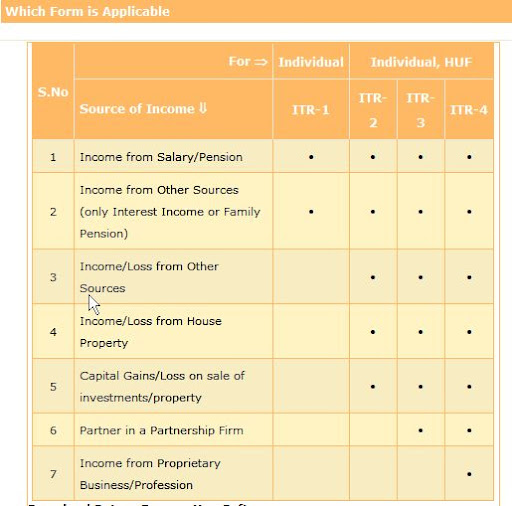
There are two income tax return forms, ITR-1 and ITR-2, for salaried individuals. Your sources of income (they will fall under one or more of the five sources mentioned earlier) will decide your form. You will have to submit the filled form to the tax authorities and get an acknowledgement from them.
Income source decides return form
ITR-1: Income from salary, pension and interest earned in a financial year
ITR-2: Capital gains, income/loss from house property and income from any other source
Use ITR-1 to file your tax return if your income is from salary, pension or interest. In case of any capital gains, income or loss from house property and income from any other source, you will have to use ITR-2. You can go to www.incometaxindia.gov.in/download_all.asp to download these forms.
You will find ITR-1 relatively simple to fill up. A prerequisite for the exercise is Form 16, the certificate that comes from the employer showing the TDS from the income chargeable under the head salary. ITR-1 is almost a replica of Form 16. All you have to do is pick the numbers from Form 16 and put them in the ITR form.
Apart from salary income, there is an important component of income that many taxpayers ignore while filing their returns. It is the interest income earned from the funds lying in savings accounts in banks. Disclosing that, however small it may be, is mandatory.
You just have to add the total interest credited to your bank account in the last financial year. Scrutinise your income tax return to ensure that no taxable income is undisclosed. After you file your return, the tax authorities will hand you an acknowledgment. That's it, you are through with the filing of returns.
You will need to fill up ITR-2 if you, as a salaried individual, have made any capital gains. This form is filled in the same way as ITR-1. In addition, you will have to fill in income, if any, from house property and other sources.
How to file
The actual filing of return can be done either by using the traditional paper form or electronically, over the Internet. The second, known as e-filing, is fast catching up. The digital method is compulsory for companies, but optional for salaried individuals still. However, it may well become compulsory for individuals with a certain level of income in times to come. So, it may not be a bad idea to familiarise yourself with this process.
Before you start filing the return, check if you would be getting a refund from the IT Department or have to pay tax. In case of the latter, even before starting the filing process, you should first get hold of Form 280, fill it up and deposit it any bank along with the tax payable in cash or cheque. You can also pay tax through Internet banking. In both cases, you will get a receipt number which has to be quoted in the ITR form.
Doing it offline
There are two options - you may either submit the ITR form at the nearest income tax office after filling it up yourself, or you may get a chartered accountant or a tax return preparer to do it for you. Try to visit the ITO well before the last date for filing return as crowds increase as 31 July draws near.
You may also take help from the public relations officer of the ITO to fill the form. No documents or investment proofs need to be attached with the form, but remember to bring photocopies or originals with you to the ITO. These will come in handy if you are asked to authenticate the maths.
The fee of a CA would depend on your income slab and the number of income sources. Typically, it would range from Rs 300 to Rs 2,000, depending on the complexities involved. One good thing about filing through a CA is that it would bring down the margin of error to nil. Also, depending on the acumen of the CA, which often gets reflected in the quality of his practice, he would suggest some tax saving ways to you for the future.
Doing it online
E-filing is done through sites authorised by the IT Department to file taxes on your behalf. To e-file, you will have to input the details of Form 16 in the software of the website, which would automatically generate an electronic return in XML format.
This format helps in sharing of structured data across different information systems. A PDF file of the relevant ITR form is also created along with the XML format. You can download this ITR form, submit it at the ITO and get an acknowledgement.
Save the XML file to your desktop and then upload it on incometaxindiaefiling.gov.in - the IT Department site. Some sites also have provision for online payment of tax. Use of a digital signature will render the e-filing process complete without involving paperwork and visits to the ITO.
In case DS is used, the acknowledgement will be emailed to you. If you upload the file on the tax department's site without the DS, the acknowledgement, called ITR-V, emailed to you will have to be submitted at an ITO within 15 days of downloading it. A DS can be acquired from any of the agencies authorised by the government for the job, including the private and government websites meant for filing tax returns.
E-filing is not just convenient and saves time, it can also be done from anywhere. What is especially important is that the online method reduces or even eliminates the interface between the tax assessee and tax officials.
Online sites
Among the major sites offering e-filing facilities are Taxspanner, Taxsmile and Taxshax. You can either take printouts of the relevant ITRs from these three sites and physically submit them or upload your XML file on the IT Department's site.
Taxspanner uploads the taxpayer's file directly and emails ITR-V to him. With Taxsmile, you can submit the forms at any of its offices spread over the country. They will then forward it to the ITO.
All the three sites are secure and easy to navigate. The major difference among them is on two counts - the number of income sources covered and the process. Get clarity on the cost and features offered. The minimum cost package would normally be only for salary income. The advanced version might be required if you have income from other sources.
The tax sites also differ in the way they ask for information and allow you to input figures. Taxshax gets most of the figures filled up in a single page. Taxspanner has a step-by-step guide and takes one piece of information on one page. Taxsmile gives both these options.
Use of DS raises the cost of e-filing. The amount of this increase varies across tax sites. A DS can be obtained from Taxsmile for Rs 500. Apart from this, you will have to pay for the basic package. Your DS comes with a validity period, after which it has to be renewed.
A DS from Taxspanner, for example, is valid for two years. This site offers a deal in which you can file returns for three years at a cost of Rs 250 a year. To get your DS from a tax site, download the relevant form from it, attach the required documents, such as your identity and address proofs, and courier them to the address concerned. The entire process of acquiring a DS may take around 15 days.
A tax return can also be filed from the government site - incometaxindiaefiling.gov.in/portal/index.jsp - meant for it. Your PAN will work as the username for registering at this site.
Should you go online?
Internet accessibility is growing, but it is still out of reach for many of the 40 million taxpayers. For those who have access to it and want to save time, the digital signature way looks ideal - you will be able to file the return in a few minutes from the comfort of your home or office. E-filing without the DS is almost the same as filing returns offline.
Tax laws can often seem like a cross between a Rubik's cube and Mutthiah Muralitharan's spin bowling. The three private tax sites get around this by making themselves friendly to taxpayers and not making filing of return dependent on an intricate understanding of the workings of tax laws. They empower with information and knowledge while taking the taxpayer step-by step through the entire process of tax filing. The details of the return filed get saved in the database of these sites and can be accessed anytime in the future.
If you have any specific doubts concerning the filing process, email the tax site to clear them. Getting clarity is important as some sites do not include things like income from business or profession, losses of earlier years brought forward or clubbed income. If tax is due, check if you can pay it through the site.
Stick to the deadline
Whether you are going offline or online, make sure your are on the right side of 31 July. If tax is due and return is not filed till 31 March of the following year, a penalty of Rs 5,000 is levied. Penalty may also have to be paid in the form of interest. Check out the answers on the next few pages to some frequently asked questions to get on top of tax returns. And then go ahead and file with a smile.
Source::http://www.rediff.com/money/2008/jul/07tax.htm
Tuesday, July 8, 2008
Moneycontrol.com The Indian sensex and the google trends
The G8 summit where Manmohan Singh will attends, the declaration to go to IAEA, the left thus withdrawing the support and an impending TRUST VOTE on the fllor of the house means that the economic and energy market in India is very volatile. So were the technical chartbusters in the sensex.
Crucially it was interesting to note that moneycontrol topped google trend analysis. Such was the interest from 10am to 3 pm.